Tequendamense
Recently published species of Anthurium
Anthurium tequendamense
Vannini & Croat, 2024 | F1 specimen
Here's the thing about Anthurium tequendamense. it's a textbook example of what responsible plant commerce looks like, and if you're collecting aroids right now, you should understand why that matters.
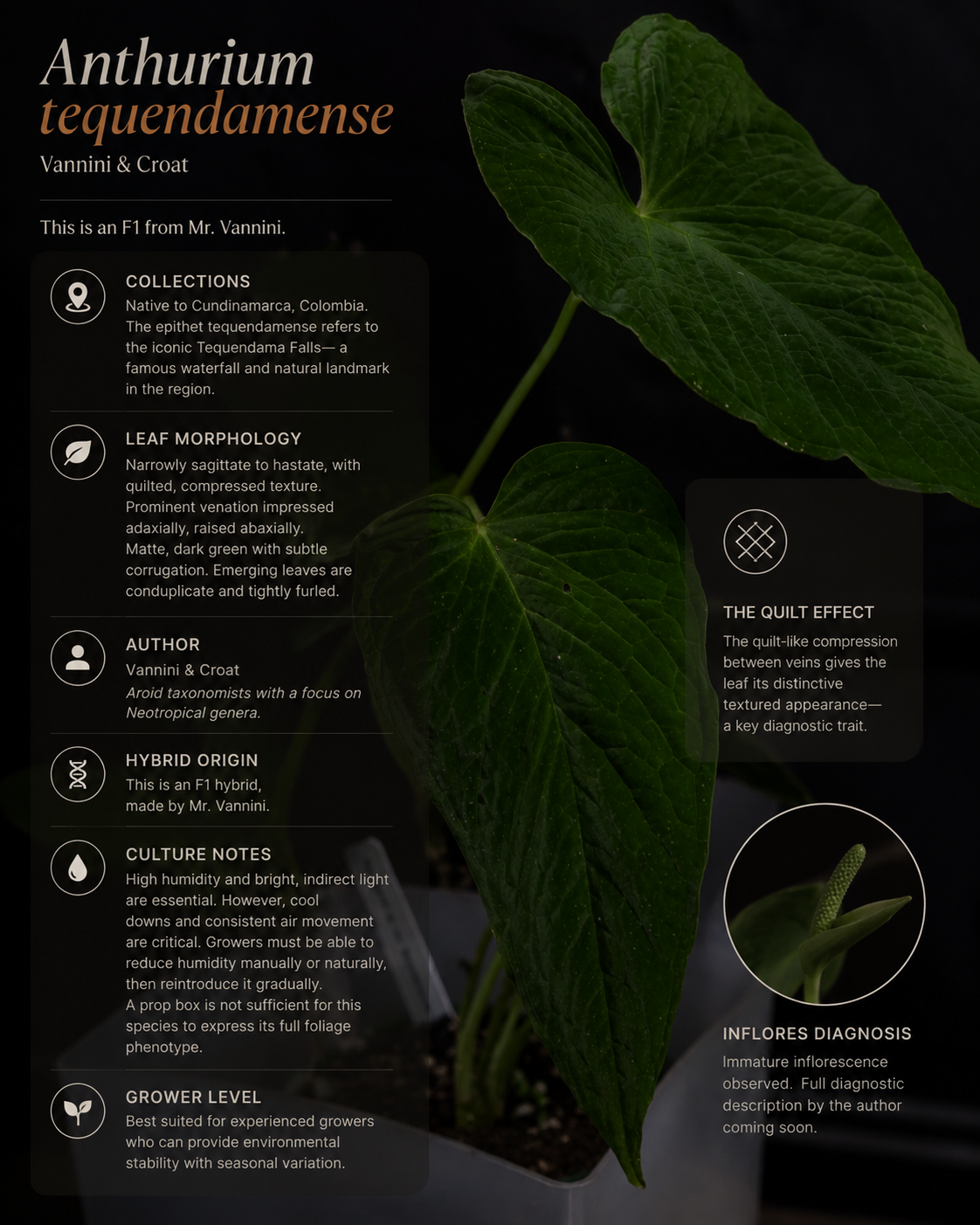
The species is native to Cundinamarca, Colombia—the epithet refers to Tequendama Falls, a landmark in the region where wild material was documented. This is an F1 hybrid made by Jay Vannini, which already tells you something. A researcher and true plant-person doesn't just source plants; they understands them. I respect Mr. Vannini because he crosses them intentionally. He publishes. Then, and only then, does he make them available commercially.
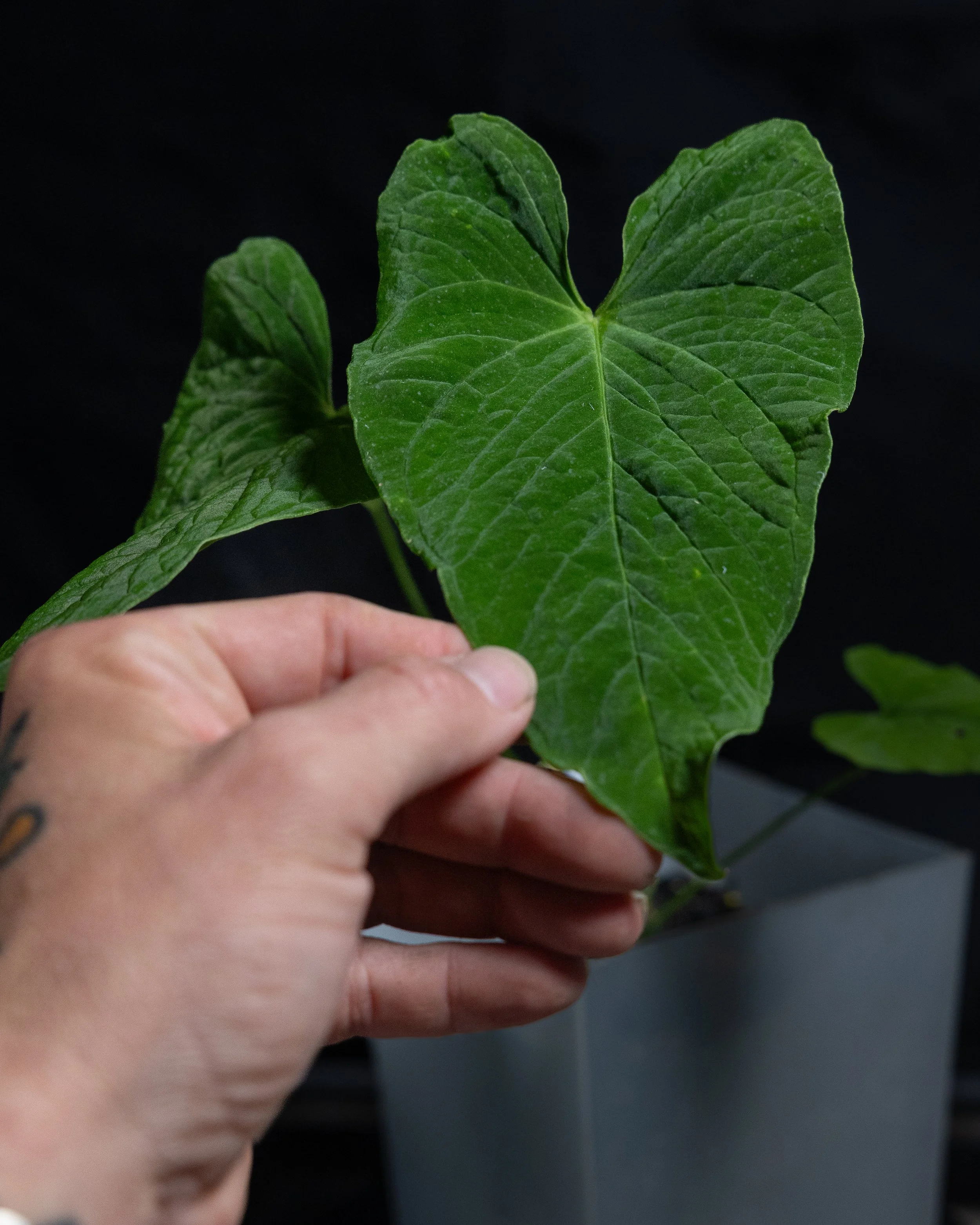
Let's talk morphology, because this is where tequendamense gets interesting. The leaf form is narrowly sagittate to hastae—not floppy or diffuse, but architecturally defined. You're looking at a plant with intention in its structure. The lobes don't sprawl; they point. That matters because it tells you something about canopy strategy in the humid Colombian understory where wild material was sourced.
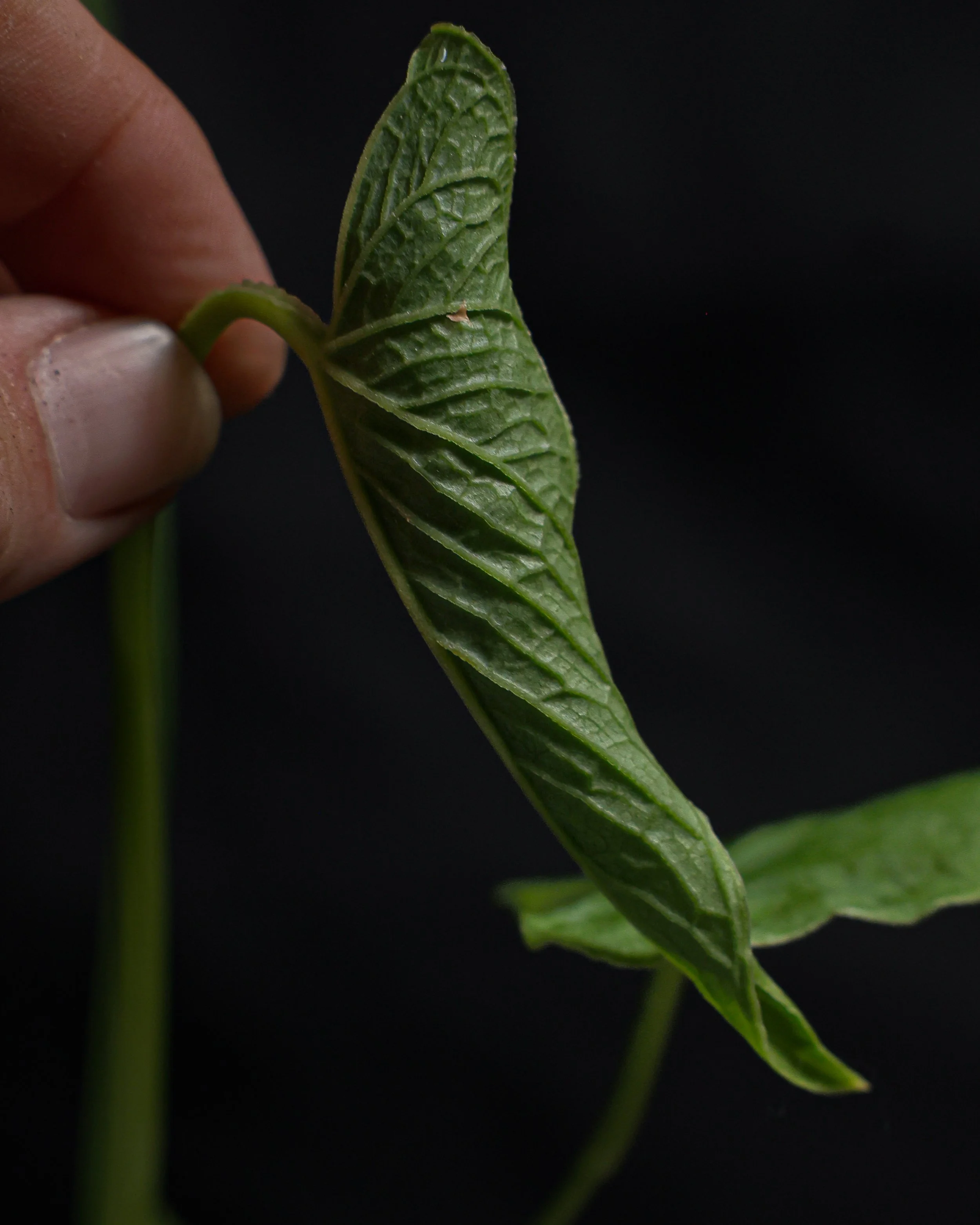
But the real diagnostic signature—the thing that will stop you mid-room—is that quilt effect; the compressed texture created by raised, adaxially impressed venation. This isn't some casual surface feature. When you look at a mature leaf, you're seeing light and shadow playing across a grid of vein-defined cells. The leaf is essentially sculpted by its own vascular architecture. It's the kind of detail that separates the "oh, that's pretty" collector moment from the "wait, why does it do that" botanist moment.
This isn't just ornamental; it's a structural adaptation. The quilting increases surface area for gas exchange while managing water loss in high-humidity environments—it's a climate signature written into the leaf surface. Emerging leaves are conduplicate and tightly furled, unfurling to reveal that same corrugated pattern. You watch new growth emerge like small green origami, then gradually flatten into those compressed folds.
The color is dark green with subtle corrugation—nothing flashy, but that's the point. The plant isn't screaming for light; it's *made* for the middle story. Matte finish in high-humidity tropical conditions is the opposite of a weakness; it's a feature that prevents excess light reflectance and manages condensation. That "dull" surface you might see in standard greenhouse photos is actually the plant showing you exactly where it evolved.
Here's what separates a scientifically aligned approach from the typical extract-and-sell model: the prior acknowledges specificity as a feature, not a liability. This species demands experienced growers—not because it's temperamental or difficult in some romantic, gatekeeping sense, but because it's specific. High humidity, bright indirect light, cool temperature swings, and actual air movement aren't negotiable requests; they're structural requirements. A prop box is insufficient. The plant will survive in one, sure. But it won't express its phenotype. It won't show you why it matters.