One Plant Before Its Name
Anthurium sp. nov. Honduras
I keep one plant under the label Anthurium sp. nov. Honduras. Sp. nov. means “new species,” but until a formal description is published, this is a working identity: an Anthurium believed to be undescribed and associated with Honduras. I have not observed a wild population, compared preserved specimens, or studied the variation between individuals. This is not a species account. It is an encounter with one cultivated plant—a particularly pretty critter that has become useful as a muse.
Even one individual gives us plenty to observe.
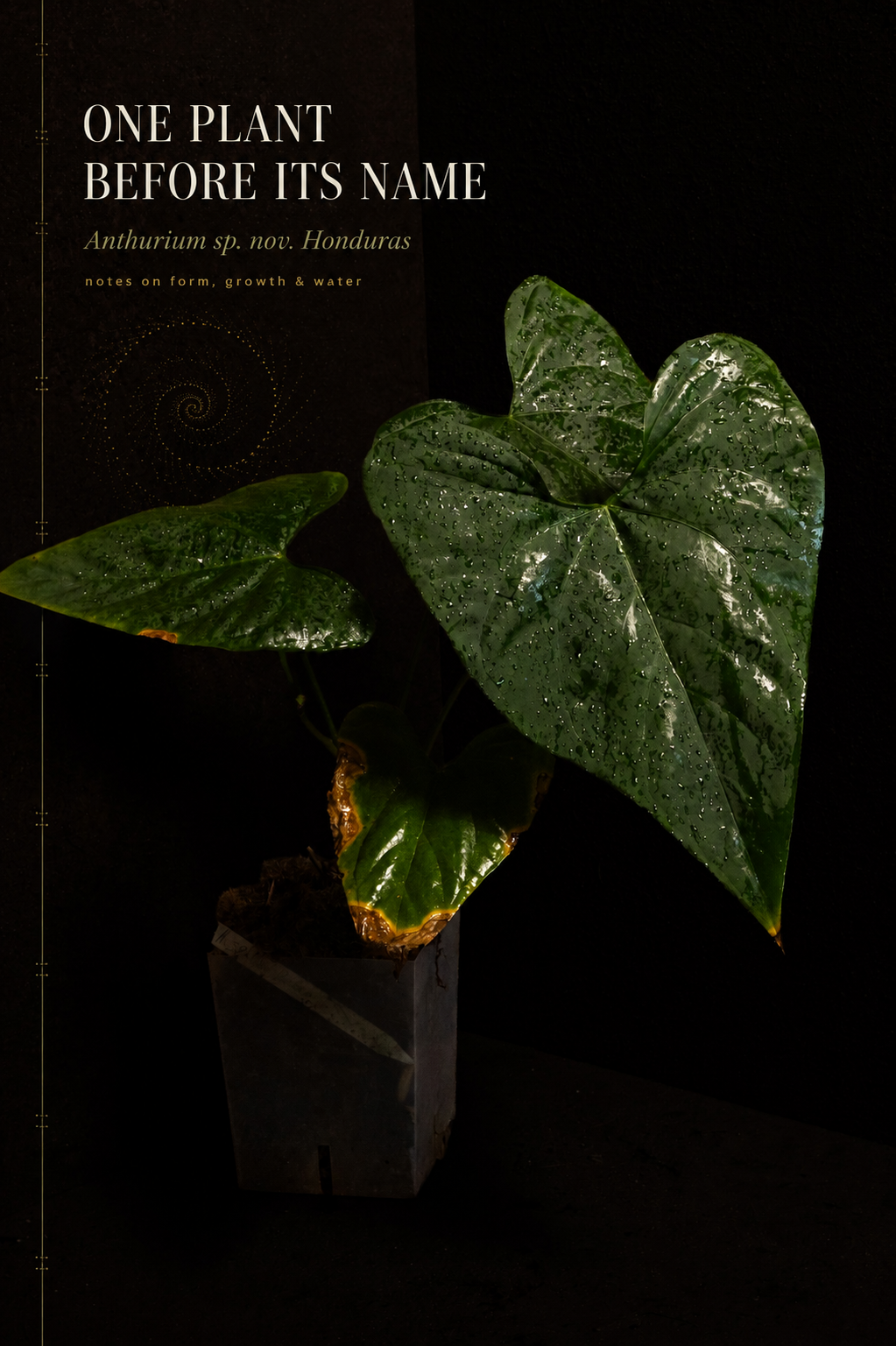
Its mature leaves are broadly sagittate to hastate: arrow- to spear-shaped, with two basal lobes spreading away from a long anterior lobe. The margin is entire, without teeth or divisions, and the blade narrows gradually into a pointed tip. Several primary veins radiate from the petiole insertion before smaller veins distribute through the dark-green surface. The veins sit slightly recessed, giving the blade a shallow, three-dimensional texture.
The leaves are also noticeably thick. They feel more substantial than their elegant outline suggests, and the plant produces unusually robust roots. In cultivation, those roots remind me of Anthurium clarinervium and A. leuconeurum, two Mexican species that also build dense leaves above heavy root systems. That is a grower’s comparison, not evidence of a close evolutionary relationship. It simply describes how this plant occupies a pot: the foliage may look refined, but the structure below it is not delicate.
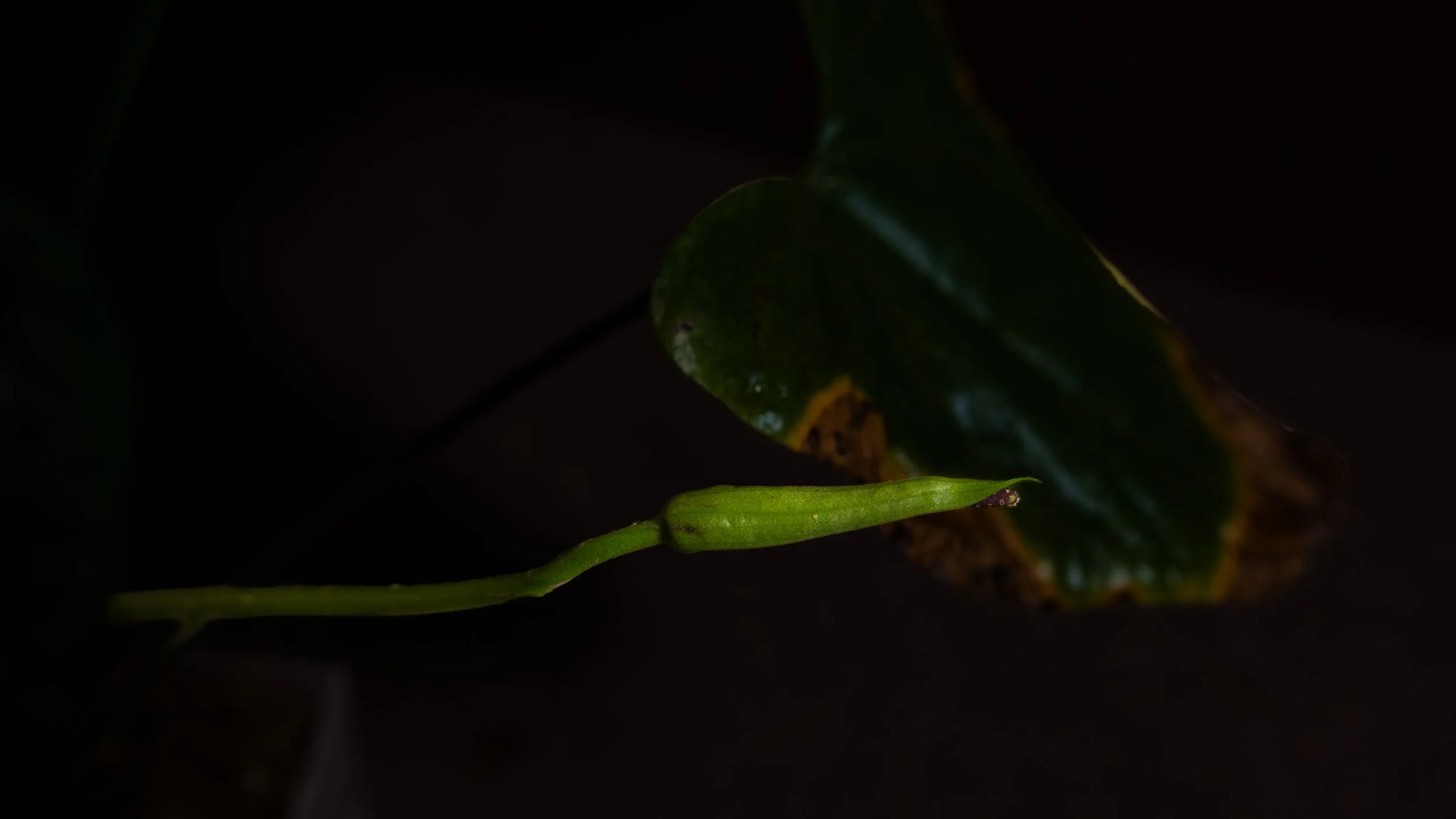
The inflorescence narrows that mass into a completely different geometry. A long, slender peduncle carries a green, lance-shaped spathe that initially wraps closely around the lower portion of a dark violet-brown spadix. The spathe extends into a drawn-out point before pulling away and exposing more of the spadix.
The spadix is not a single flower. It is an unbranched, fleshy axis covered with many tiny flowers. Each flower is sessile, meaning it attaches directly to the axis without its own stalk. Viewed closely, the flowers appear packed into diagonal spirals. The glistening beads visible across this inflorescence are consistent with the stigmatic exudate produced during the receptive female phase, although I would need to follow several complete flowering cycles before describing this individual’s timing with confidence.
This arrangement gives us a concrete way to think about inflorescence geometry. Many flowering structures create space through branches, internodes, and individual flower stalks. This Anthurium does almost none of that. Its topology—the basic map of what connects to what—is simple: one axis, no branches, and many flowers attached directly to it. Its complexity comes from geometry and time instead. Flower position, packing density, spiral angle, and the sequence of maturation transform a plain cylinder into a reproductive architecture.
That architecture begins in a meristem, a small region of dividing cells from which new plant structures develop. As the plant enters a reproductive phase, floral meristems form repeatedly across the developing spadix. Each local initiation contributes to phyllotaxis, the regular arrangement of plant organs around an axis. No individual flower contains a plan for the completed structure. The global spiral emerges through repeated local interactions among growing tissues, biochemical signals, spatial constraints, and inherited developmental rules.
This is self-organization in its useful sense—not disorder somehow becoming magical, but a coherent pattern arising without a single part directing the whole.
The German physicist Hermann Haken developed a framework called synergetics to study this kind of cooperative pattern formation. One of its central ideas is the order parameter: a collective variable that describes the large-scale organization of a system and constrains the possible behavior of its smaller parts. In a developmental model of this spadix, the angle separating successive floral primordia or the position of the maturation wave could serve as candidate order parameters. I am not claiming to have measured them here. The plant simply provides a physical handhold for the concept: many small events become understandable through a few relationships operating across the whole structure.
The leaves show the complementary process of differentiation. Differentiation occurs when cells carrying essentially the same genome take on different structures and functions. The same growing system that compresses flowers into a narrow cylinder also produces broad, thick, dramatically lobed leaves. Differences in gene activity, hormone distribution, tissue mechanics, and local growth rates draw out the anterior lobe, expand the basal lobes, and establish the radiating veins. The leaf’s beauty is not decoration placed over the biology. Its shape is the visible history of development.
Water makes another set of relationships visible. On a wet leaf, gravity pulls each droplet downward while surface tension and adhesion resist that movement. Microscopic variations in wax, texture, veins, and surface chemistry can pin the edge where air, water, and leaf meet. Physicists describe part of this resistance through contact-angle hysteresis: the difference between the angle at the advancing edge of a droplet and the angle at its receding edge. The droplet moves only when gravity, wind, or movement of the leaf overcomes that retention.
I have not measured the contact angles of this plant, but its wet leaves make the contest visible. Droplets remain scattered across sloping blades, caught by small differences in surface and angle. The thick leaf is not merely a background for the water. It is a mechanical surface that curves, supports weight, and directs each droplet toward a possible path.
In indoor pot culture, this individual prefers deep shade—roughly 100–200 foot-candles—and consistently wet substrate. Wet cannot be allowed to become stagnant, so steady airflow remains essential. Its robust roots also benefit from generous pot volume and an aerated medium rather than being compressed into a small, saturated center. These are observations from one plant under one set of conditions, not universal instructions for a species that has not yet been formally described.
I do not need this individual to represent an entire Honduran population. It can remain what it is: one beautiful organism, temporarily named, allowing me to watch geometry emerge from meristems, broad leaves differentiate from shared developmental material, and water negotiate its passage across a living surface.