SOIL MY WAY
Approx. 5 min read. Visual anchor: Anthurium dressleri, F2, Río Guanche line.
This is not a fit-in-the-box soil piece. No purpose. No poetry. It is systems thinking and soil dynamics run against one cherry-picked case, for one reason: to show that decay, rot, and adaptation are not three things happening near each other. They are one process, and it is legible.
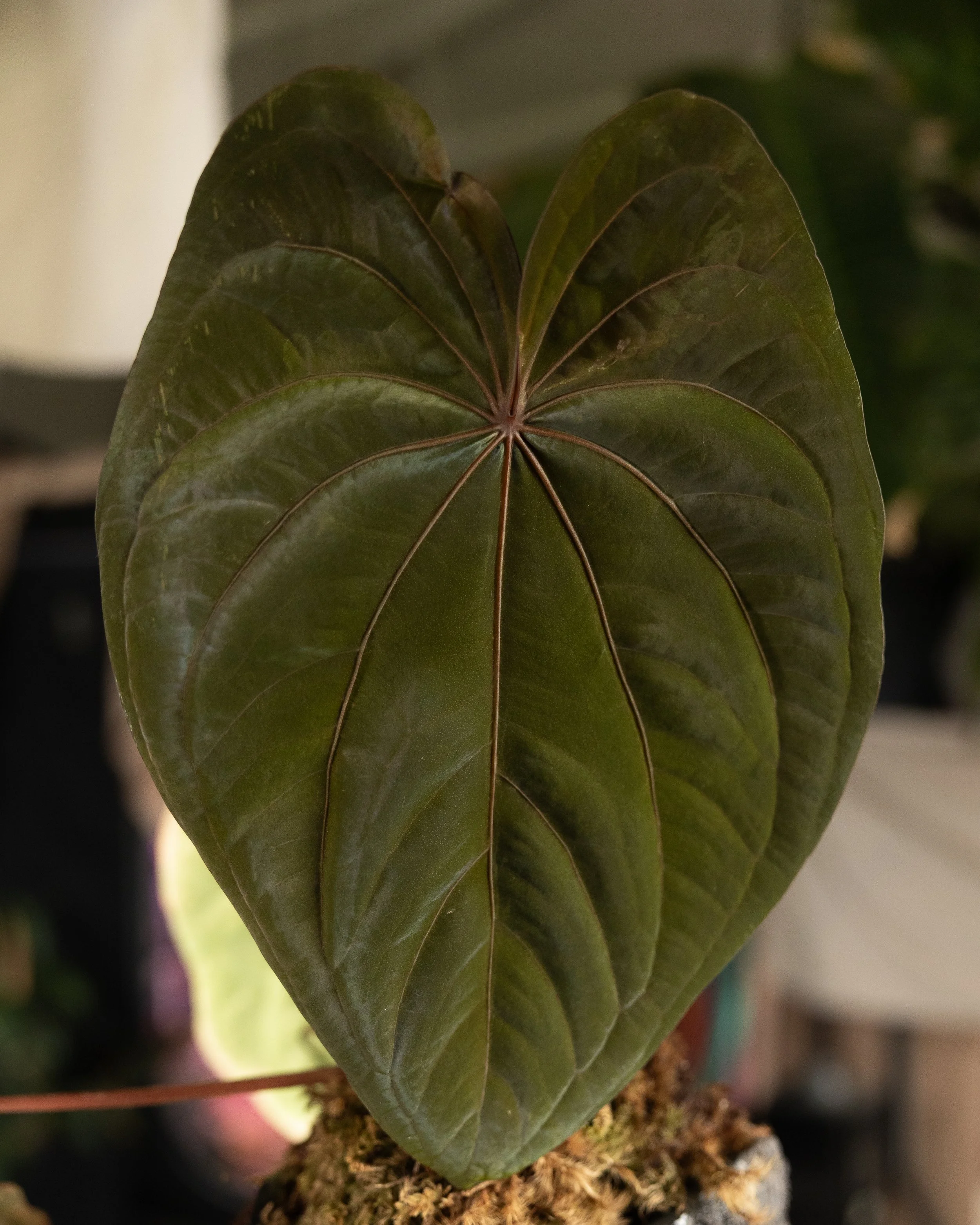
emerging leaf on Anthurium dressleri
The ledger is wrong
Lateritic rainforest soils get called agriculturally sub-optimal. Sub-optimal for what, on whose books.
Industrial row-crop accounting asks for available phosphorus, base saturation, pH near neutral, cation exchange capacity you can bill against. Highly weathered wet-tropical soils fail on those lines and the forest standing on top of them does not care, because the forest is not running that ledger. Fittkau and Klinge established the shape of it fifty years ago at Manaus: the nutrient capital of a central Amazonian forest is not banked in the mineral soil, it is held in the standing biomass and the litter above it (Fittkau & Klinge 1973, Biotropica 5:2–14). The soil is not the account. It is the floor the account sits on.
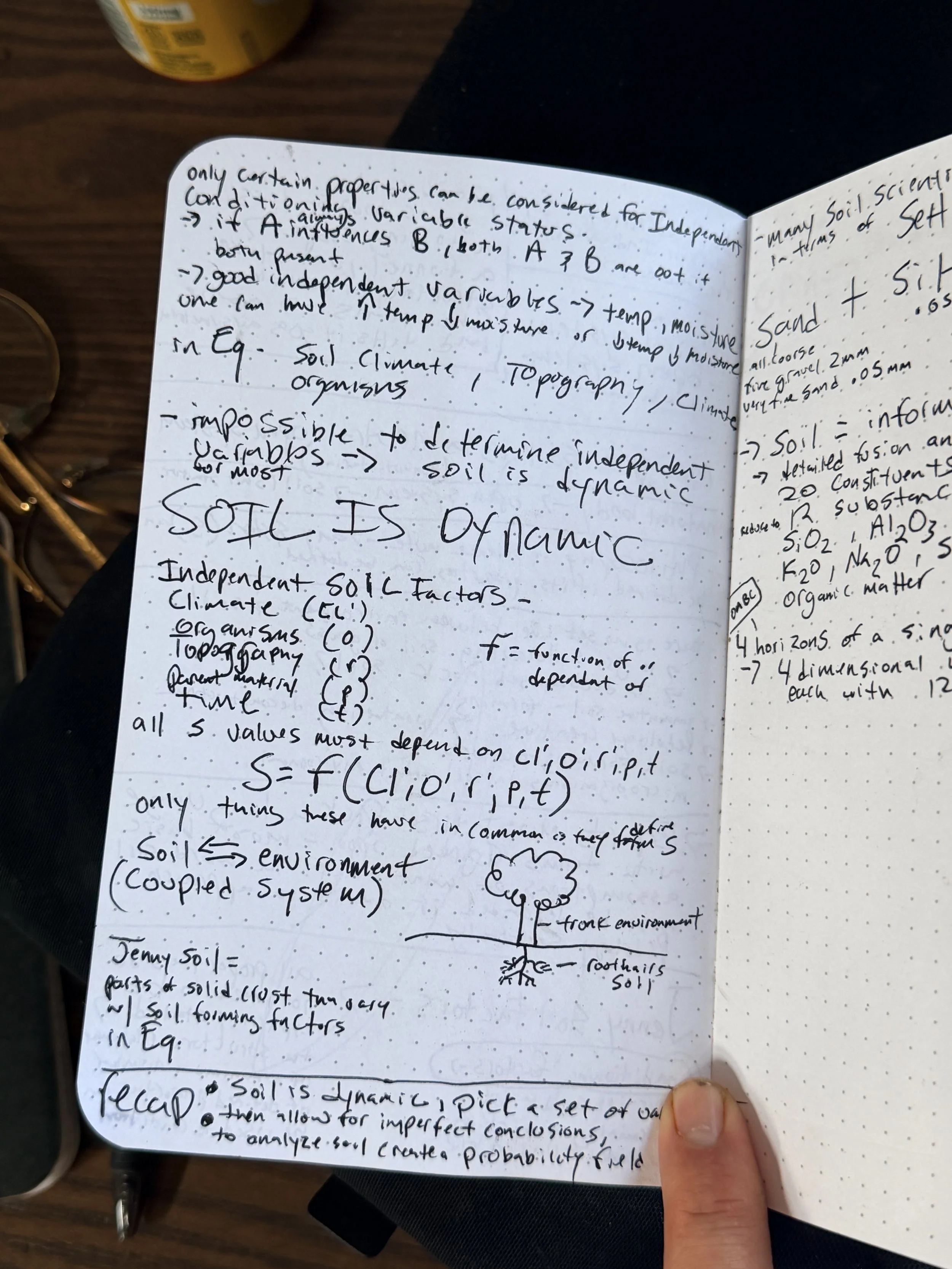
Hans Jenny gave us the grammar for reading that in 1941. Soil as a function of climate, organisms, relief, parent material, and time — s = f(cl, o, r, p, t). Note where organisms sit in that equation. Not as a tenant responding to soil conditions. As a state factor. The plants are an input to the soil, not just an output of it. The relationship runs both directions and always did.
Aluminum is the lock
Here is the mechanism the agronomic frame is actually reacting to.
As these soils acidify below roughly pH 5.5, aluminum stops being inert structure and starts appearing in solution as exchangeable Al³⁺ — the rhizotoxic species, the one that damages root tips and shuts down root extension. Simultaneously, the iron and aluminum oxides that dominate the clay fraction of a deeply weathered profile adsorb phosphate. High surface area, high positive charge density under acid conditions, electrostatic capture first, then ligand exchange as the phosphate ion displaces a surface hydroxyl and the bond becomes durable. The result is a soil that can carry a respectable total phosphorus number while almost none of it is available to a plant.
Two constraints, one chemistry. Aluminum poisons the root and locks the phosphorus in the same motion. That is the box.
The forest routes around it
Stark and Jordan sprayed radiotracer calcium-45 and phosphorus-32 onto surface root mats over oxisols and spodosols at San Carlos de Río Negro and put lysimeters underneath. In nearly every case, less than a tenth of a percent of the tracer made it past the root–organic mat. Within one to two months, leakage stopped entirely (Stark & Jordan 1978, Ecology59:434–437).
Read that as an engineering result. The forest built an interception layer above the problem and does not let nutrients enter the mineral soil, because entering the mineral soil is where they get taken. Herrera, Mérida, Stark and Jordan documented the transfer step the same year — phosphorus moving from decomposing leaf litter into roots through fungal connection, without ever passing through soil solution (Herrera et al. 1978, Naturwissenschaften 65:208–209).
Jay Vannini's field observation puts the horticultural point on it: understory plants on these iron-rich soils root into the litter layer, not the soil beneath it. They are not tolerating bad soil. They are not using it.
Surface area is the whole trick
The litter mat wins on dimension.
A root is a few hundred micrometers across. A fungal hypha is a few. Swap one for the other and the absorbing surface per unit volume goes up by orders of magnitude, and the hyphae go into pore space roots physically cannot enter. Measured hyphal length densities in soil run to tens or over a hundred meters of hyphae per cubic centimeter at peak (Miller et al., Oecologia, external VAM hyphal length: 111 m cm⁻³ prairie, 81 m cm⁻³ pasture). In a highly organic tropical montane forest soil, the extraradical mycelium was found concentrated against root surfaces and decomposing leaves rather than dispersed through the matrix (Camenzind & Rillig 2013, Soil Biology & Biochemistry).
That is the move. Not more soil. More interior per cubic centimeter of soil. The system does not expand outward, it expands inward, and it does it in exactly the places where the exchange happens.
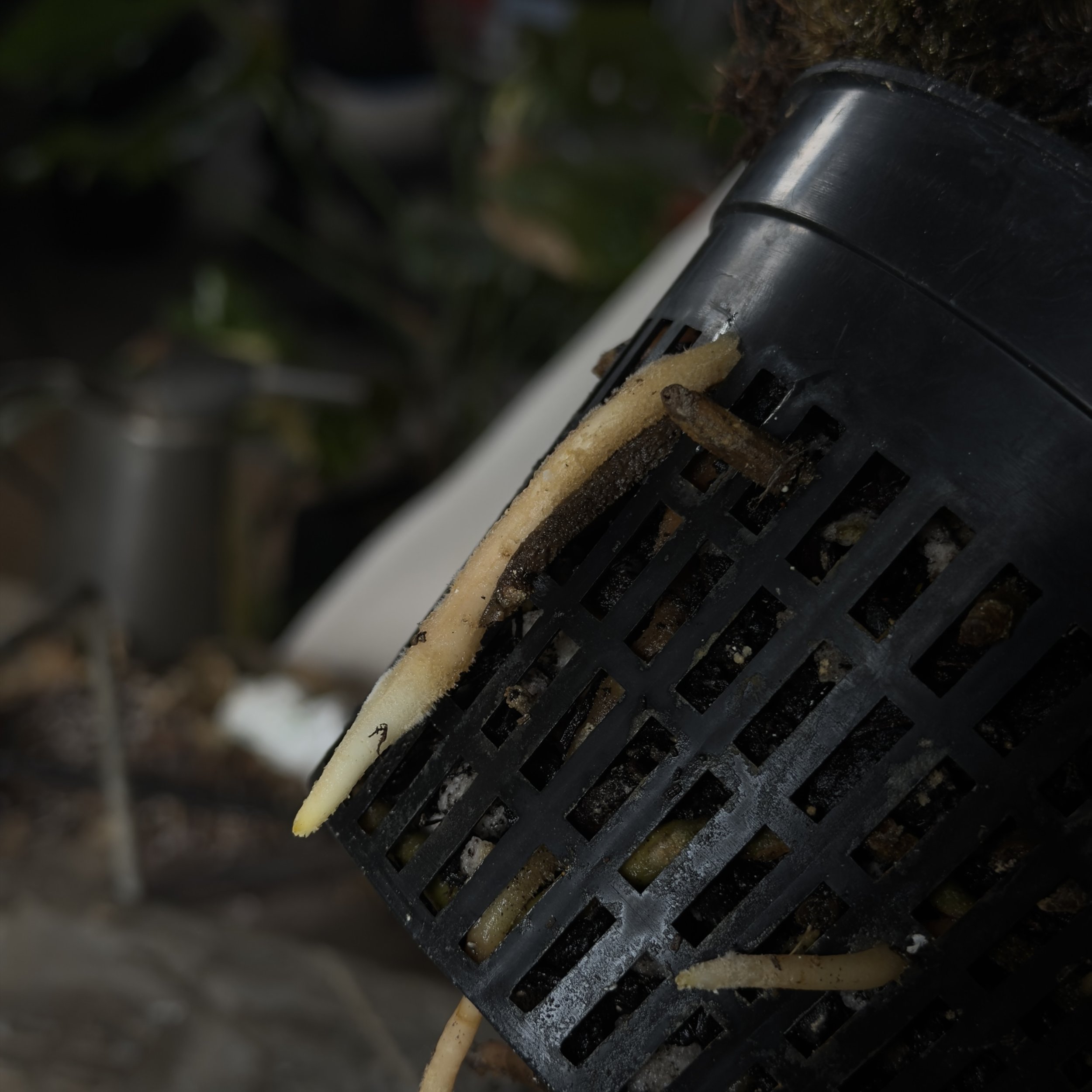
A system of decay and new growth escaping the boundary set for it by humans.
Roots grow on rotting roots
Nothing in that mat is finished. Fine roots colonize decomposing litter, die, and become the substrate the next cohort of fine roots grows into and through. Fine roots in the litter layer are morphologically different from fine roots in mineral soil — thinner, higher specific length and area, built for a different job.
Rot is not the end state of the previous structure. It is the scaffold of the next one. Decay and construction are the same operation observed at two points in time, which is the only reason the system holds together on a substrate that offers it nothing.
Ion exchange is information exchange
Strip the sentiment out and what a cation exchange site does is register a state and act on it. A charged surface, an occupancy, a displacement, a change downstream. That is a channel.
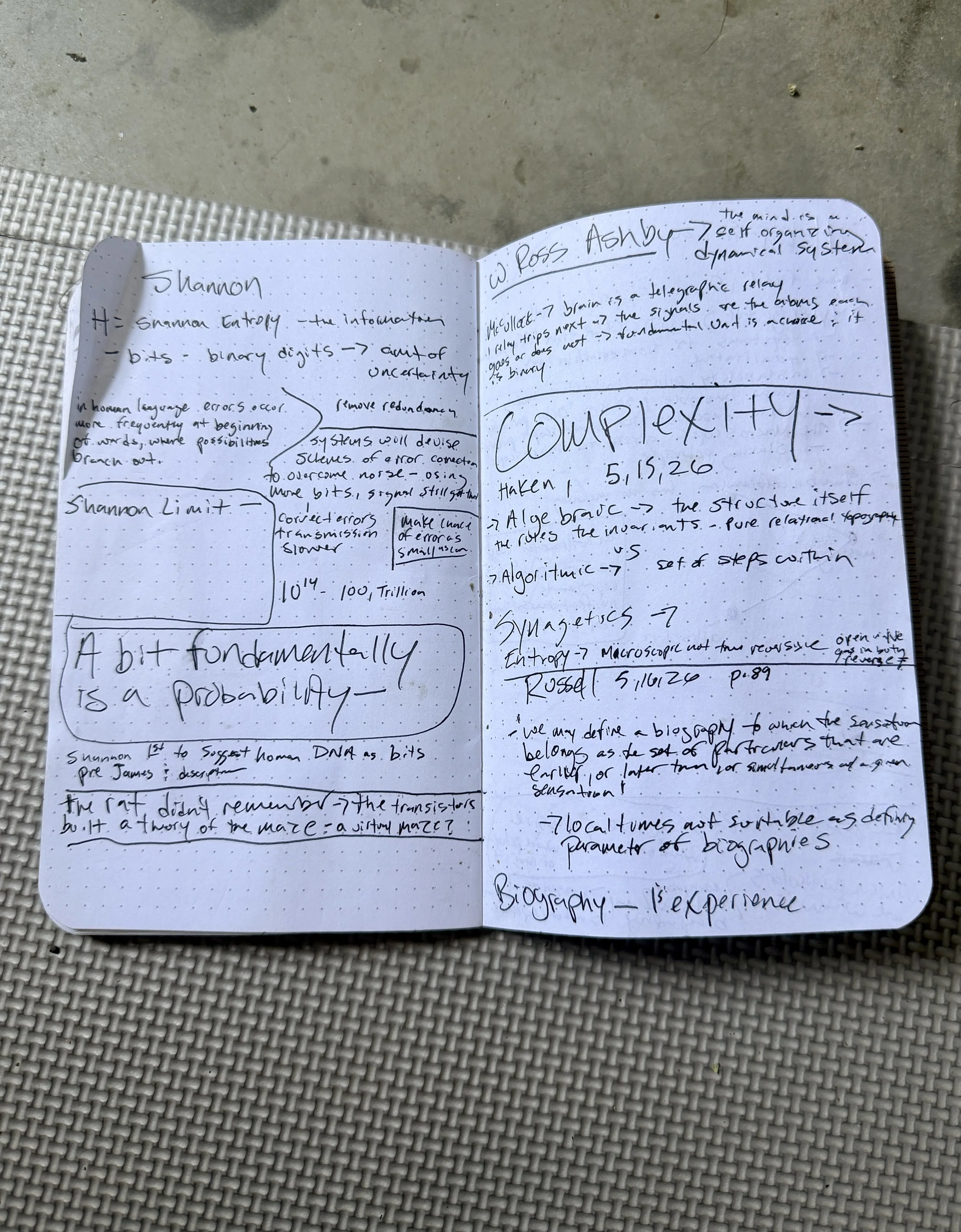
Hermann Haken's scheme is the honest formal language here: inputs distributed across a set of possible messages, coupled into a set of attractors, with Shannon entropy across the transformation telling you whether the system annihilated, conserved, or generated information at that step (Haken, Information and Self-Organization, 3rd ed., 2006). Microbial consortia processing litter into a stable community are not a metaphor for that scheme. They are an instance of it. So is a hyphal network converting a scattered field of decomposing leaves into a directed phosphorus flux with a plant on the other end.
Jenny said soil is a relationship being computed, decades before anyone would phrase it that way. Al³⁺ is one term in it. The litter mat is the system's answer.
Codex
The anchor: Río Guanche
Anthurium dressleri, section Cardiolonchium. Type locality Río Guanche, Colón Province, Panama, roughly 200 m on the Caribbean versant, wet forest — the material Croat and Vannini recircumscribed in 2010 as A. dressleri sensu stricto.
The specimen photographed here is F2 from that line. Not wild-collected. Two generations into cultivation and still carrying a direct, documented connection to the locale — which is the only version of provenance worth defending, because it means the genepool is preserved without another plant coming out of the ground.
That plant evolved into an interception layer, not a soil. Its roots want architecture, air, and a constant thin nutrient stream — a synthetic O-horizon, not a growing medium. Growers who succeed with it are approximating litter dynamics in a pot, whether or not they would describe it that way.
The soil under it was never the point. The layer above it was always the point.
Sources
Jenny, H. 1941. Factors of Soil Formation. McGraw-Hill.
Fittkau, E.J. & Klinge, H. 1973. On biomass and trophic structure of the central Amazonian rain forest ecosystem. Biotropica 5(1):2–14.
Stark, N.M. & Jordan, C.F. 1978. Nutrient retention by the root mat of an Amazonian rain forest. Ecology 59:434–437.
Herrera, R., Mérida, T., Stark, N. & Jordan, C.F. 1978. Direct phosphorus transfer from leaf litter to roots. Naturwissenschaften 65:208–209.
Bunn, R.A. et al. 2019. Revisiting the 'direct mineral cycling' hypothesis: arbuscular mycorrhizal fungi colonize leaf litter, but why? ISME Journal 13:1891–1898.
Camenzind, T. & Rillig, M.C. 2013. Extraradical arbuscular mycorrhizal fungal hyphae in an organic tropical montane forest soil. Soil Biology & Biochemistry.
Reeve, N.G. & Sumner, M.E. 1970. Effects of aluminum toxicity and phosphorus fixation on crop growth on Oxisols in Natal. SSSAJ 34(2).
Haken, H. 2006. Information and Self-Organization: A Macroscopic Approach to Complex Systems, 3rd ed. Springer.
Croat, T.B. & Vannini, J. 2010. Re-examination of Anthurium dressleri.