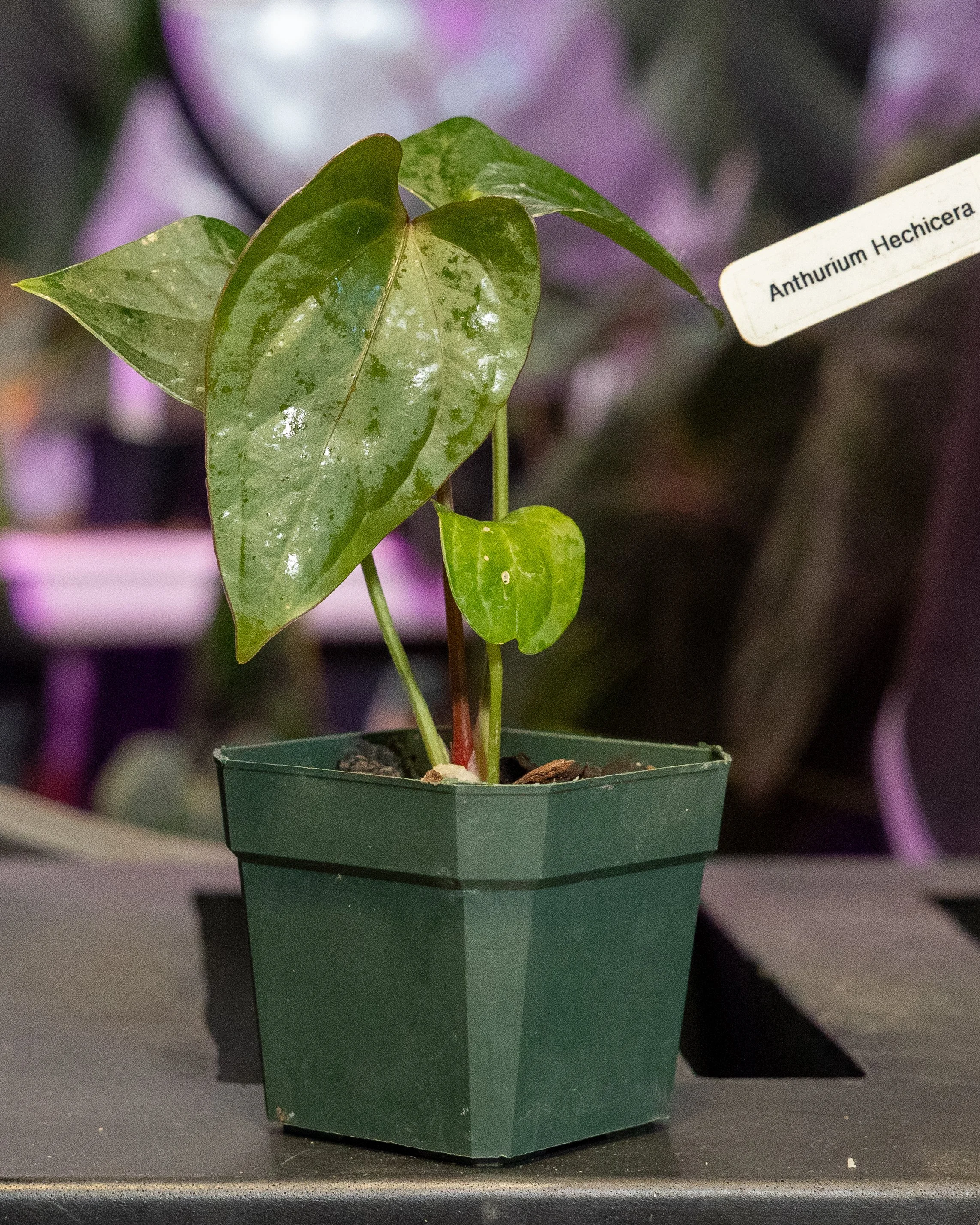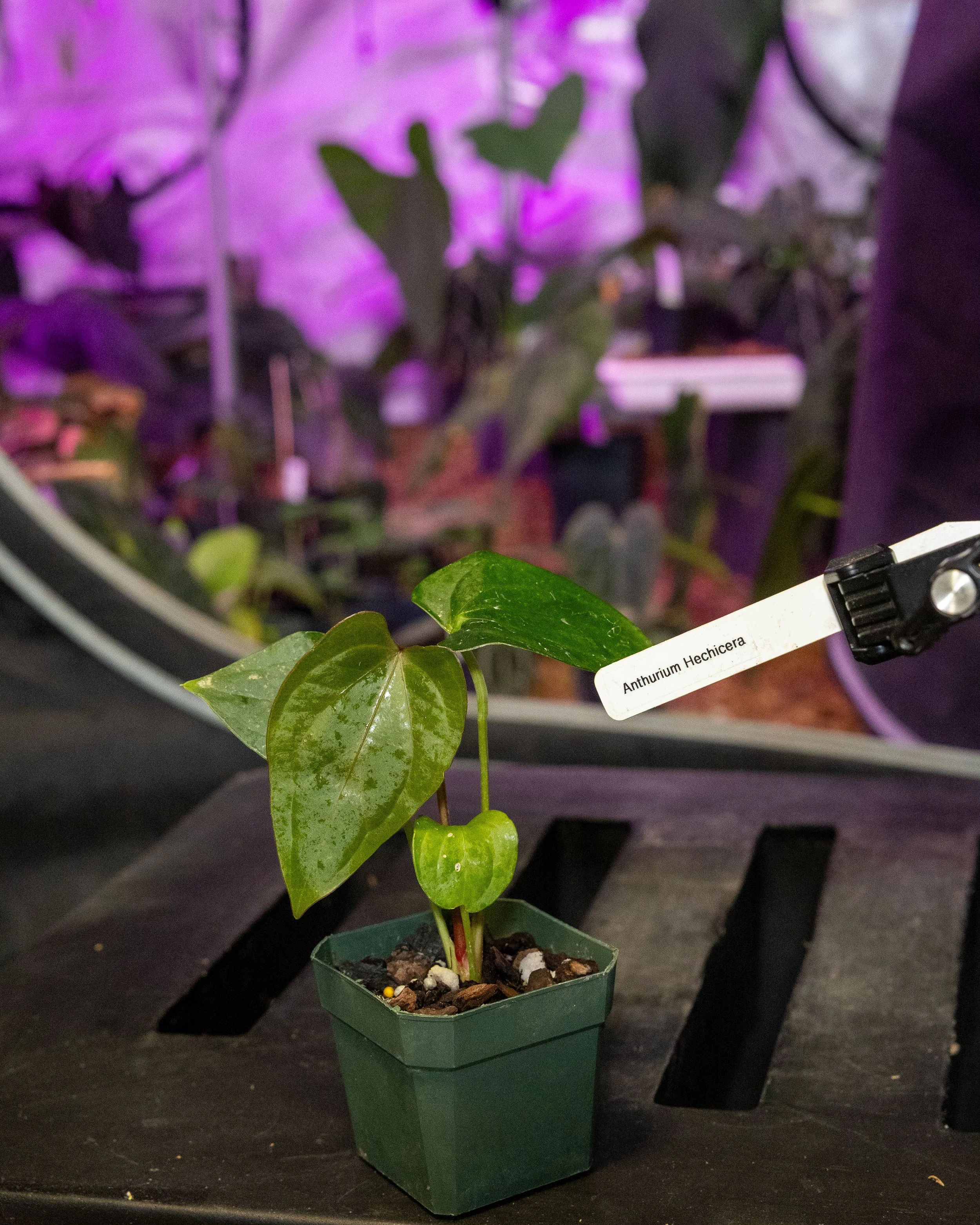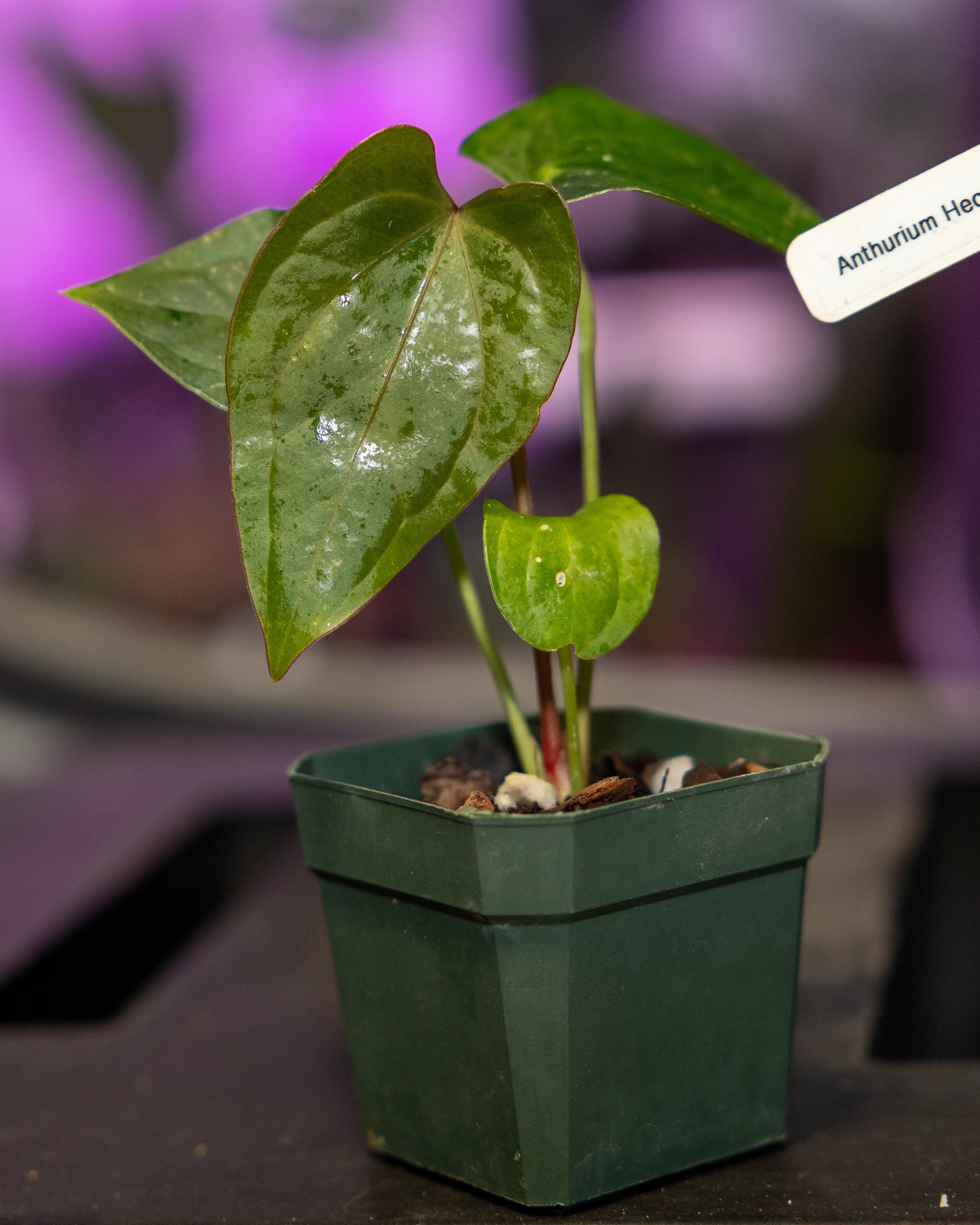
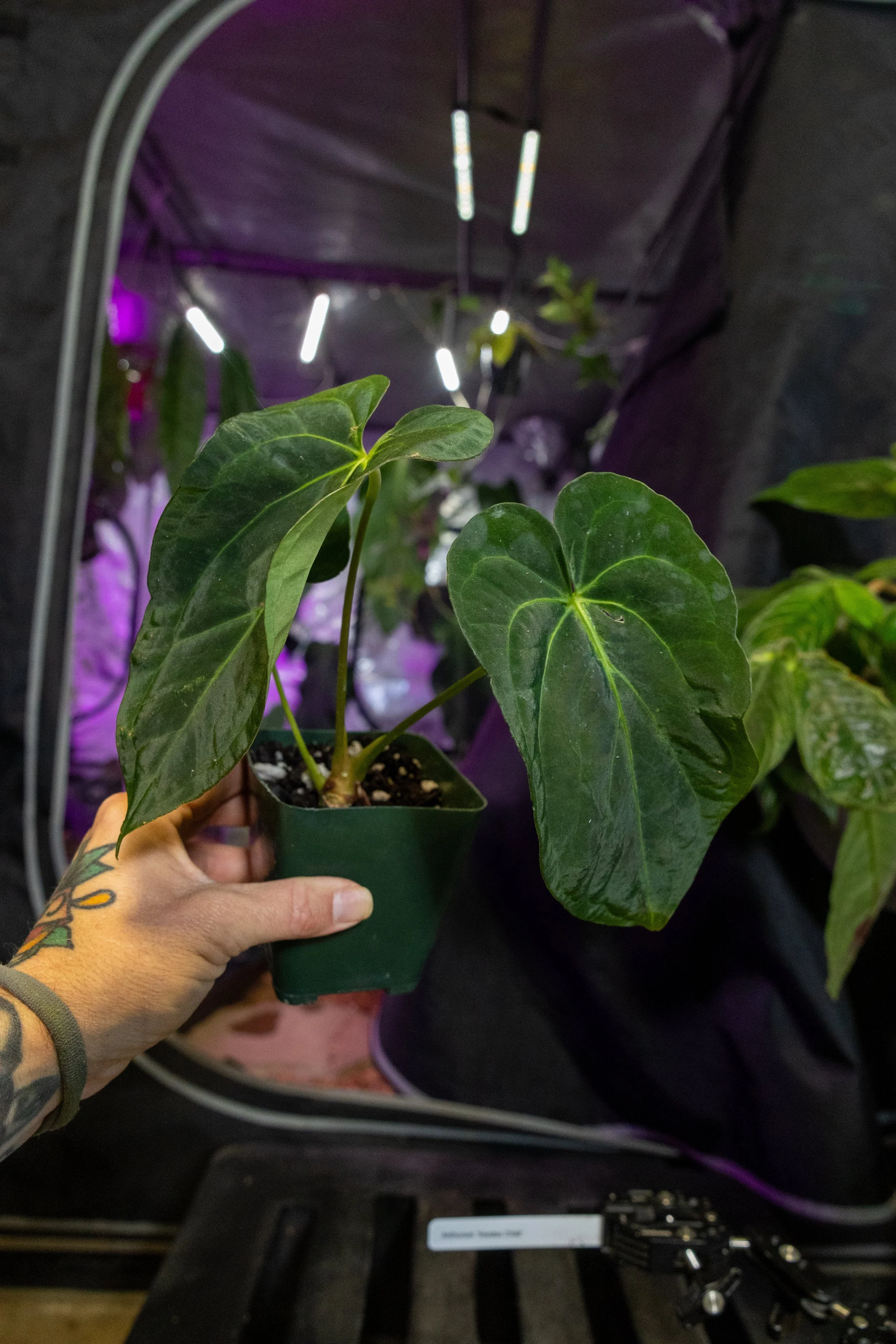
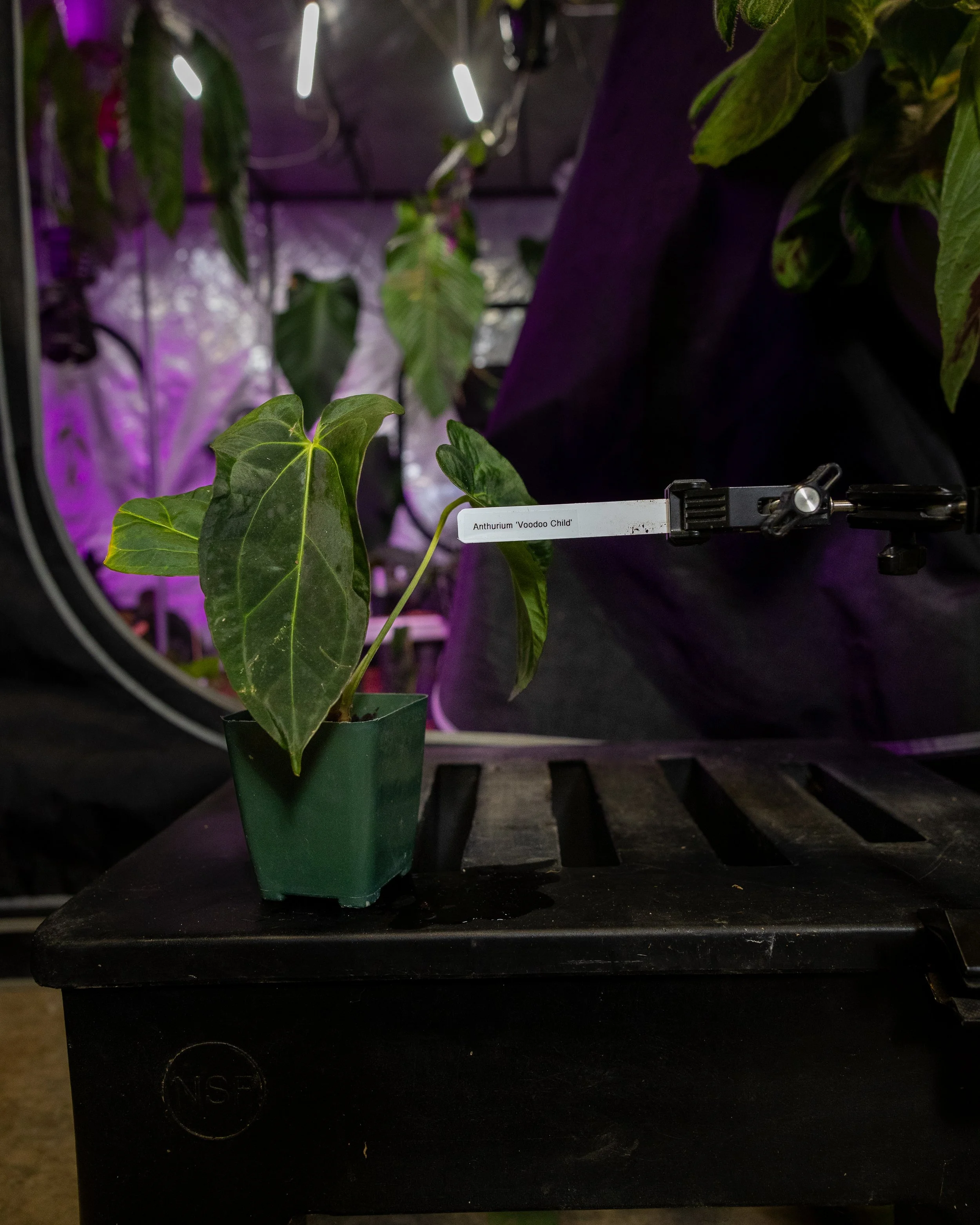
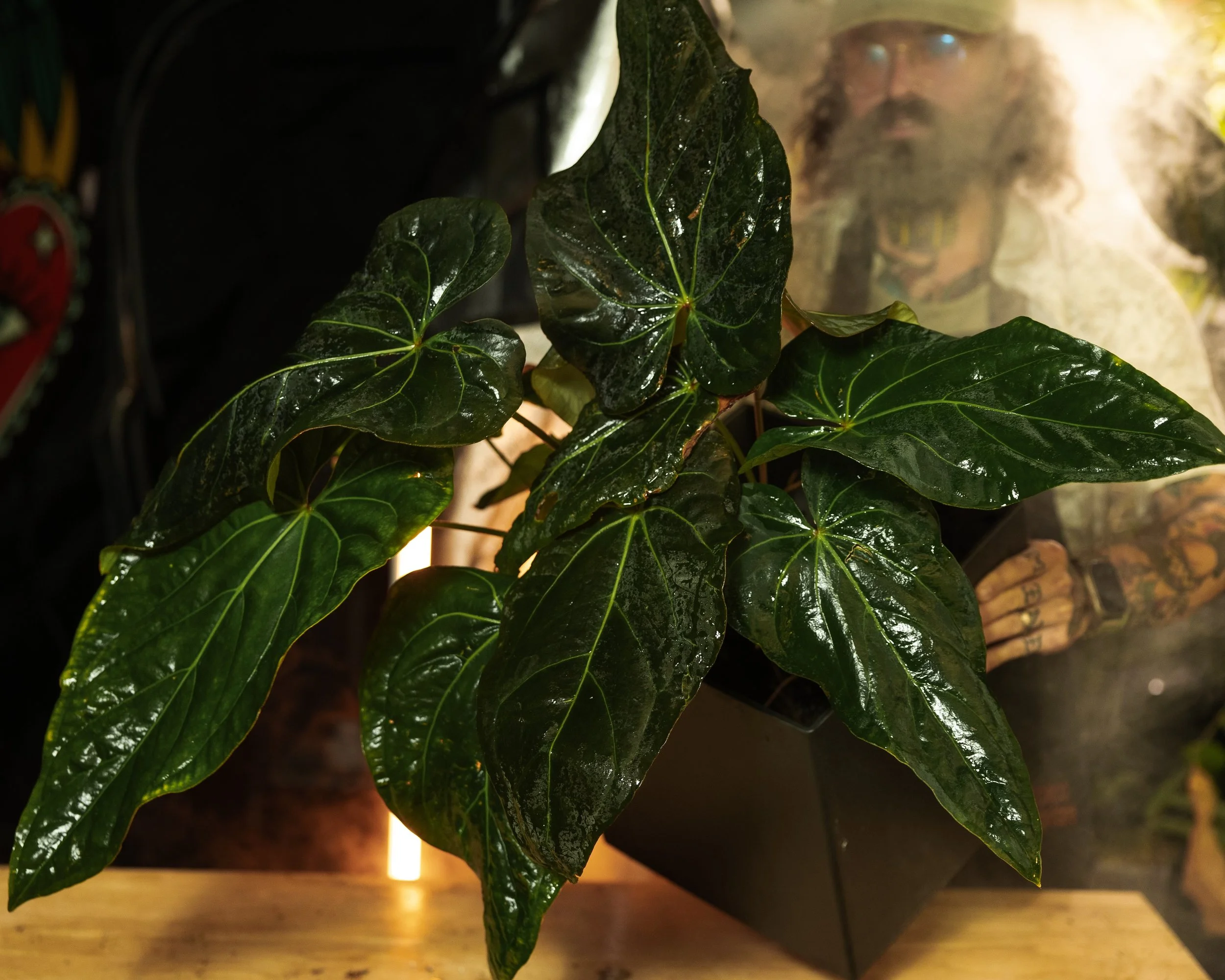
Operating in a realm of aroid mythology few commercially available plants can occupy. 'Voodoo Child' originates from a stud colony Jay Vannini established in the late 1990s. Vannini — co-author with Tom Croat on the 2010 A. dressleri re-examination, publisher of Exotica Esoterica, and curator of one of the world's most provenance-rigorous anthurium collections — selected this for size and overall leaf morphology. Its sister plant 'Red Velvet' — a name since bastardized across pop offerings — was chosen from the same cross for color. Neither has proven reproducible from seed. Neither has proven reproducible through tissue culture. What's being offered here is direct transfer from the neotropical operating system into our collections.
Section: Cardiolonchium (Linden, 1866) Leaf shape: Broadly ovate-cordate, peltate in mature specimens; blades reaching 50–100+ cm, matte velvet with pronounced silvery-white primary and secondary venation on deep green.Inflorescence (per Tropicos): Peduncle 40–50 cm, slender; spathe broadly lanceolate, green; spadix 10–15 cm, green maturing darker. Geographic distribution: Peru, eastern Andean slope; Huánuco and San Martín regions along the Huallaga River valley, north of Tingo María and Juanjuí. Ex-Moyobamba material represents the San Martín population.
Culture: Soil is an operating system capable of self-correction in nature. The Peruvian substrate runs on ectomycorrhizal networks — billions of interactions per cm³, a quantum computer beneath the litter, fixing inorganic carbon and building the least shitty environment possible. In that system these plants rot, get chewed on by insects, drown in seasonal rain — and carry on. They do it by overseeding, by elongating stems, by throwing epiphytic roots skyward out of anaerobic mud.
Indoors, material propagated from that network needs proxies for it. I've grown a succession of this exact regale clone by keeping it moist and tightly potted under intermediate LED, with RO water and a rotating nutrient schedule — CalMag, kelp, chelated iron, MaxSea, K-Lite MSU. The substrate is a long-view replication of the neotropical OS: coco coir chunks, NZ tree fern fiber, small and medium orchid bark, medium horticultural charcoal, gypsum and dolomitic lime for slow CalMag release, pumice or perlite for drainage. It's meant to last years. Repot when roots breach the bottom of the pot or you see verifiable signs of lockout. That resilience diminishes by orders of magnitude the further hybrid material drifts from the neotropical OS that built it.
Section: Cardiolonchium (Croat, Aroideana 1: 54. 1978) Type locality: Panama, Colón Province, Río Guanche, ~5 km above the Colón–Portobelo bridge, ~200 m — Croat 37000 (MO holotype). Habit & morphology: Terrestrial to lithophytic; stem to ~25 cm × 1–2.3 cm. Leaves cordate to sagittate with deep basal lobes — the optima optimorum of velvet darkness. Markedly winged petiole. Concolorous upper blade (no pale major venation — the key distinction from A. crystallinum). White anthers. Inflorescence (per Tropicos / Croat 1978): Peduncle shorter than the petiole; spathe reflexed; spadix with white anthers at anthesis. Geographic distribution: Caribbean versant of Panama, Colón Province through Comarca de Guna Yala; tropical wet and premontane rain forest, 100–500 m. Post-2010 (Croat & Vannini), Río Guanche material represents A. dressleri sensu stricto; Nusagandi-region material was split as A. kunayalense. Backstory: This is Jay's Río Guanche dressleri — the plant in his velvet-leaf article, from the line Robert Dressler originally collected and that Croat & Vannini formally recircumscribed in 2010. Getting this genepool into a grow space is not a trivial thing.
Culture: Give it Chocó — warm, wet, rarely still air. Riparian in habit. These plants are often superficially beat up in habitat and make it anyway. After eight years I've still never succeeded with anything less than F3 crosses of the species; the original line makes me nervous and I overdo everything.
First time I saw the name I was still reeling from a clarinervium purchase. An IG account was showing off new acquisitions, and she brought a dark velvety plant into the sunlight streaming through her Portland window. The gold light hit the leaf and created a glittering effect. She said the name — Voodoo Child — and I was hooked. Life has moved a lot since then. The plants have remained. Sharing this one now is informational transfer in plant form.
A note on behavior: the hybrid is a paradox. It combines the fickleness of both parents and is itself demanding — expect regale's need for substrate architecture and dressleri's atmospheric preferences in the same plant. Treat it as serious material.
Only tips I’ve pried from JV re: ‘Voodo’ is to give it occasional chelated iron and quality water.
Operating in a realm of aroid mythology few commercially available plants can occupy. 'Voodoo Child' originates from a stud colony Jay Vannini established in the late 1990s. Vannini — co-author with Tom Croat on the 2010 A. dressleri re-examination, publisher of Exotica Esoterica, and curator of one of the world's most provenance-rigorous anthurium collections — selected this for size and overall leaf morphology. Its sister plant 'Red Velvet' — a name since bastardized across pop offerings — was chosen from the same cross for color. Neither has proven reproducible from seed. Neither has proven reproducible through tissue culture. What's being offered here is direct transfer from the neotropical operating system into our collections.
Section: Cardiolonchium (Linden, 1866) Leaf shape: Broadly ovate-cordate, peltate in mature specimens; blades reaching 50–100+ cm, matte velvet with pronounced silvery-white primary and secondary venation on deep green.Inflorescence (per Tropicos): Peduncle 40–50 cm, slender; spathe broadly lanceolate, green; spadix 10–15 cm, green maturing darker. Geographic distribution: Peru, eastern Andean slope; Huánuco and San Martín regions along the Huallaga River valley, north of Tingo María and Juanjuí. Ex-Moyobamba material represents the San Martín population.
Culture: Soil is an operating system capable of self-correction in nature. The Peruvian substrate runs on ectomycorrhizal networks — billions of interactions per cm³, a quantum computer beneath the litter, fixing inorganic carbon and building the least shitty environment possible. In that system these plants rot, get chewed on by insects, drown in seasonal rain — and carry on. They do it by overseeding, by elongating stems, by throwing epiphytic roots skyward out of anaerobic mud.
Indoors, material propagated from that network needs proxies for it. I've grown a succession of this exact regale clone by keeping it moist and tightly potted under intermediate LED, with RO water and a rotating nutrient schedule — CalMag, kelp, chelated iron, MaxSea, K-Lite MSU. The substrate is a long-view replication of the neotropical OS: coco coir chunks, NZ tree fern fiber, small and medium orchid bark, medium horticultural charcoal, gypsum and dolomitic lime for slow CalMag release, pumice or perlite for drainage. It's meant to last years. Repot when roots breach the bottom of the pot or you see verifiable signs of lockout. That resilience diminishes by orders of magnitude the further hybrid material drifts from the neotropical OS that built it.
Section: Cardiolonchium (Croat, Aroideana 1: 54. 1978) Type locality: Panama, Colón Province, Río Guanche, ~5 km above the Colón–Portobelo bridge, ~200 m — Croat 37000 (MO holotype). Habit & morphology: Terrestrial to lithophytic; stem to ~25 cm × 1–2.3 cm. Leaves cordate to sagittate with deep basal lobes — the optima optimorum of velvet darkness. Markedly winged petiole. Concolorous upper blade (no pale major venation — the key distinction from A. crystallinum). White anthers. Inflorescence (per Tropicos / Croat 1978): Peduncle shorter than the petiole; spathe reflexed; spadix with white anthers at anthesis. Geographic distribution: Caribbean versant of Panama, Colón Province through Comarca de Guna Yala; tropical wet and premontane rain forest, 100–500 m. Post-2010 (Croat & Vannini), Río Guanche material represents A. dressleri sensu stricto; Nusagandi-region material was split as A. kunayalense. Backstory: This is Jay's Río Guanche dressleri — the plant in his velvet-leaf article, from the line Robert Dressler originally collected and that Croat & Vannini formally recircumscribed in 2010. Getting this genepool into a grow space is not a trivial thing.
Culture: Give it Chocó — warm, wet, rarely still air. Riparian in habit. These plants are often superficially beat up in habitat and make it anyway. After eight years I've still never succeeded with anything less than F3 crosses of the species; the original line makes me nervous and I overdo everything.
First time I saw the name I was still reeling from a clarinervium purchase. An IG account was showing off new acquisitions, and she brought a dark velvety plant into the sunlight streaming through her Portland window. The gold light hit the leaf and created a glittering effect. She said the name — Voodoo Child — and I was hooked. Life has moved a lot since then. The plants have remained. Sharing this one now is informational transfer in plant form.
A note on behavior: the hybrid is a paradox. It combines the fickleness of both parents and is itself demanding — expect regale's need for substrate architecture and dressleri's atmospheric preferences in the same plant. Treat it as serious material.
Only tips I’ve pried from JV re: ‘Voodo’ is to give it occasional chelated iron and quality water.