
Unnatural Nature

Anthuriums have taken on a new persona to plant collectors.
The genus once known for cut flowers is now all about the foliage.
By foliage I mean giant velvety leaves:

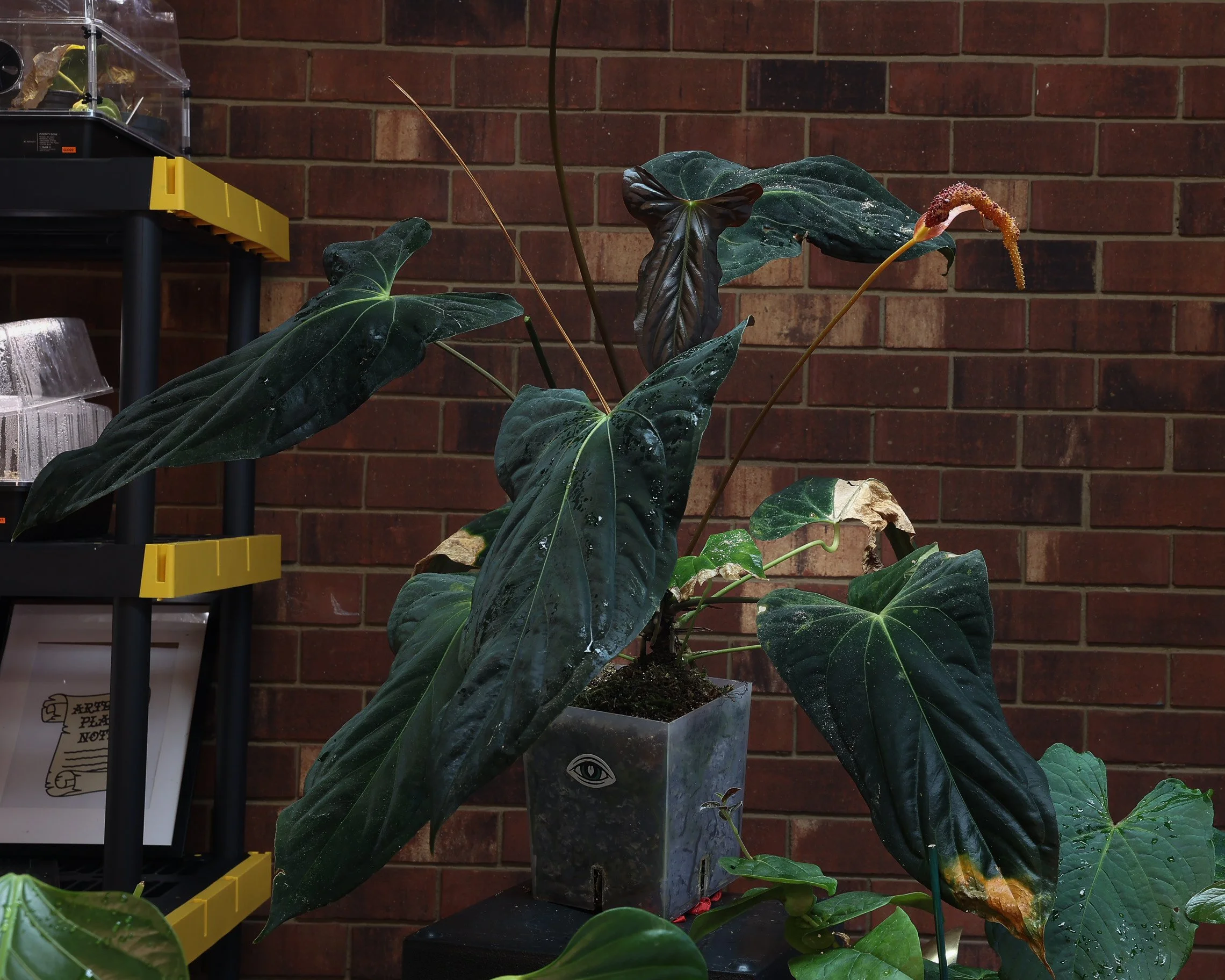
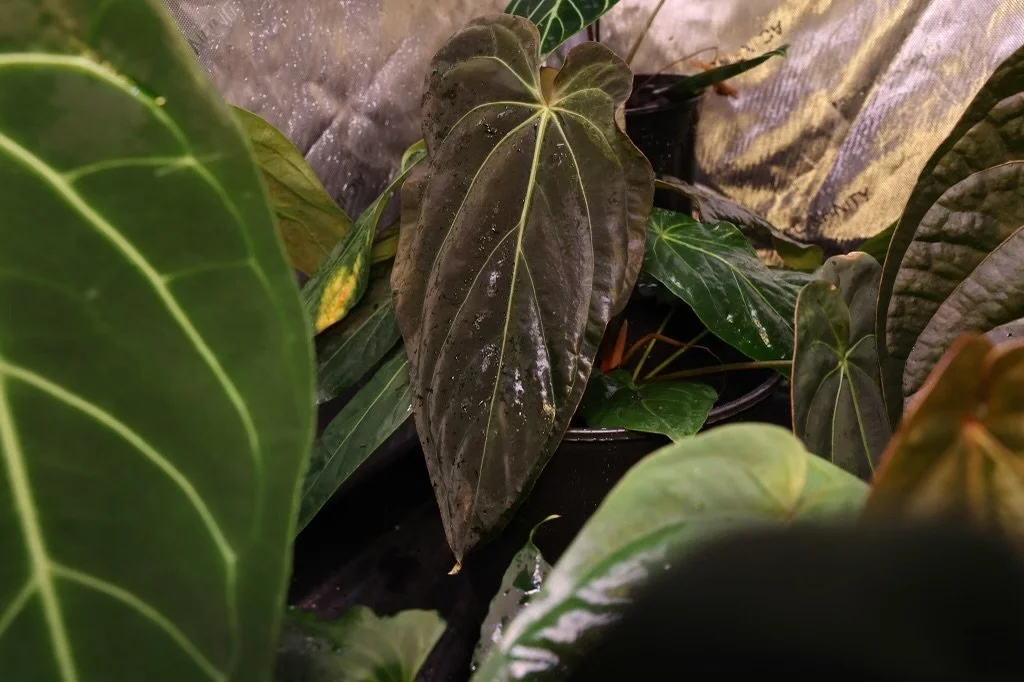
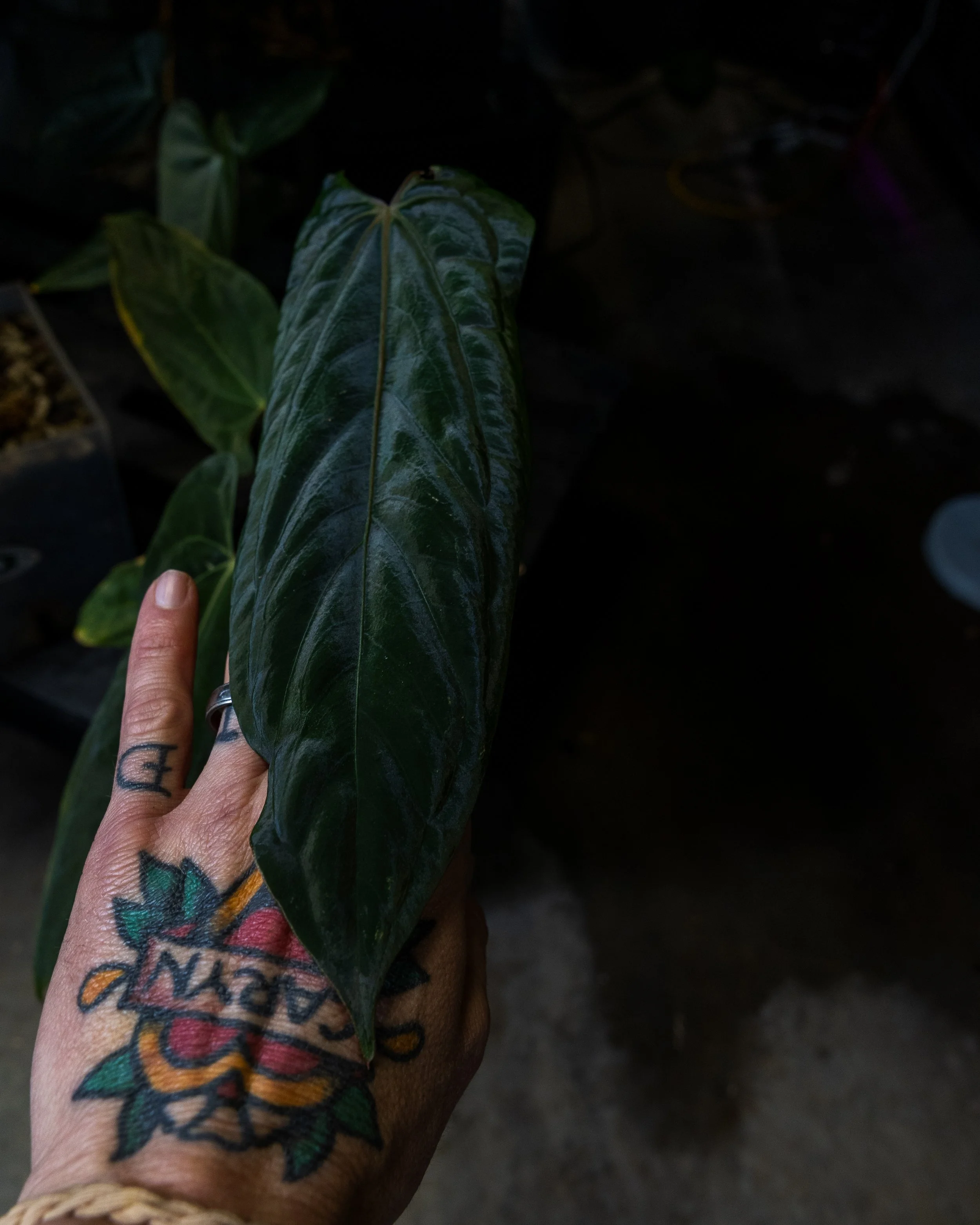
Also big glossy leaves.

Anthurium nervatum grown from a seedling in the Garage Tropics.

There are at least 1000 accepted species of anthurium and the list is constantly evolving. Last year (2025) Tom Croat published 63 new anthurium species alone. The range and diversity of the genus invites wild speculations by experts as to the total number of species, but it is safe to say that there are a lot of anthuriums.
My research shows that about 200 species of anthurium are available commercially. If one accounts for hobbyist bred material and hybrids the number of anthuriums circulating in the plant community alone are pretty intense.
The genus was once synonymous with cut flowers. Waxy red spathes in hotel lobbies, florist coolers, and waiting rooms. Anthurium andraeanum everywhere. What collectors now chase is completely different: velvet, bullation, dark pigmentation, venation so pronounced it looks pressed from below.
The hobby shifted inside five years. The old persona was bland.. The new one is set to a beat, and a leaf you want to run your hand across.
Reddit, TikTok, Instagram all have millions of plant collectors actively engaged on their platforms sharing their experiences. Anthurium specific communities all searching for that next dark velvet leaf.
Enter: Anthurium clidemiodes:

Of all the Anthuriums there is only one that combines:
Leaf shape: cordate to ovate-cordate
Surface texture: strongly bullate — the tissue between veins is raised into pronounced convex blisters or pustules
Venation: pinnate with strongly impressed primary and secondary veins creating the quilted appearance; veins sunken adaxially (upper surface)
Color: deep dark green, nearly melanistic adaxially
Surface quality: coriaceous (leathery), appearing matte with slight velutinous (velvety) quality
Margin: entire
Apex: acute to shortly acuminate
Moisture: guttation droplets visible along midrib — the plant is actively pushing water through hydathodes, a sign of healthy root pressure
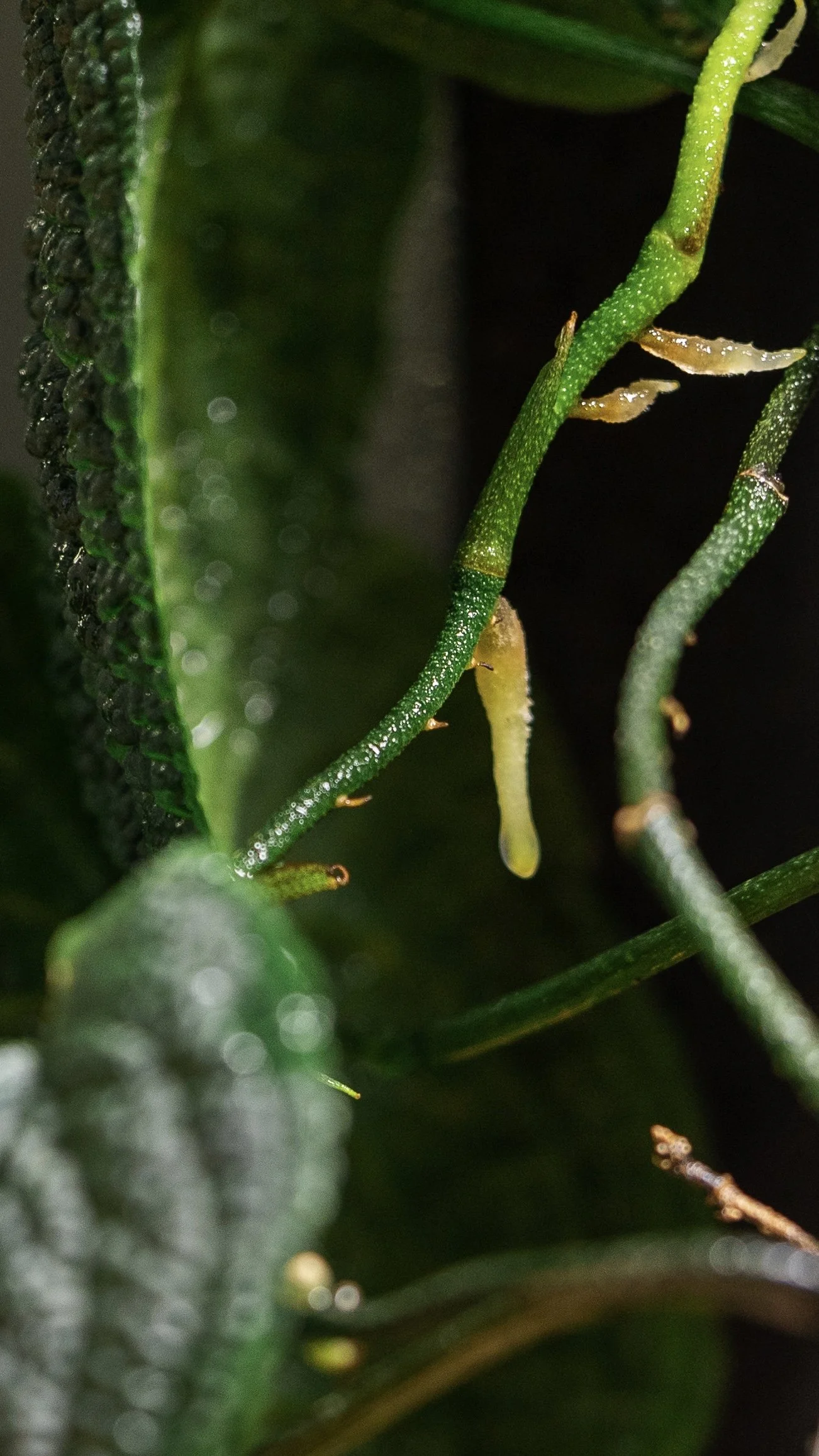
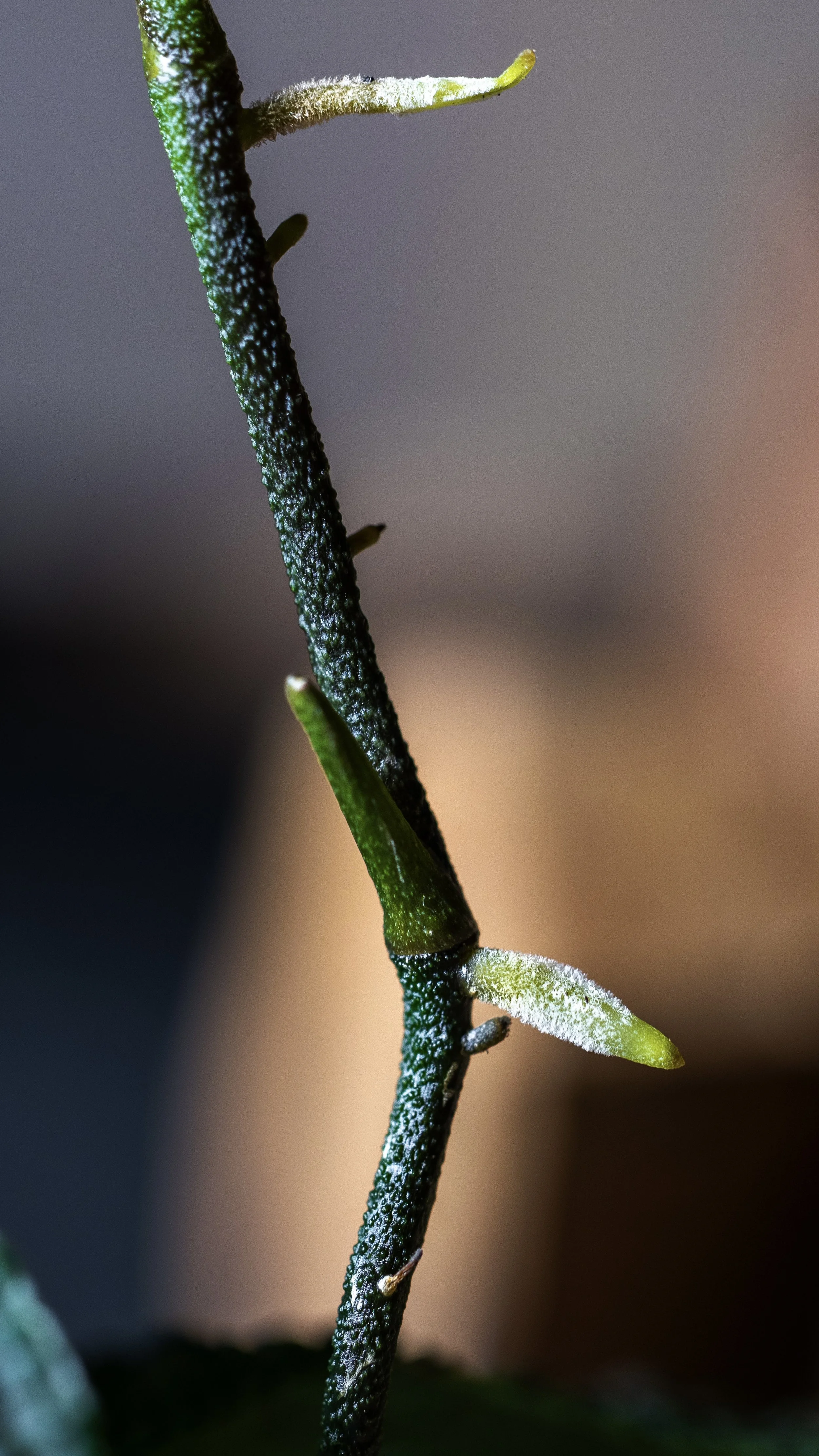
Growth Habit: hemiepiphyte scandent, uses roots to climb and cling to surface while retaining roots in ground-level media.
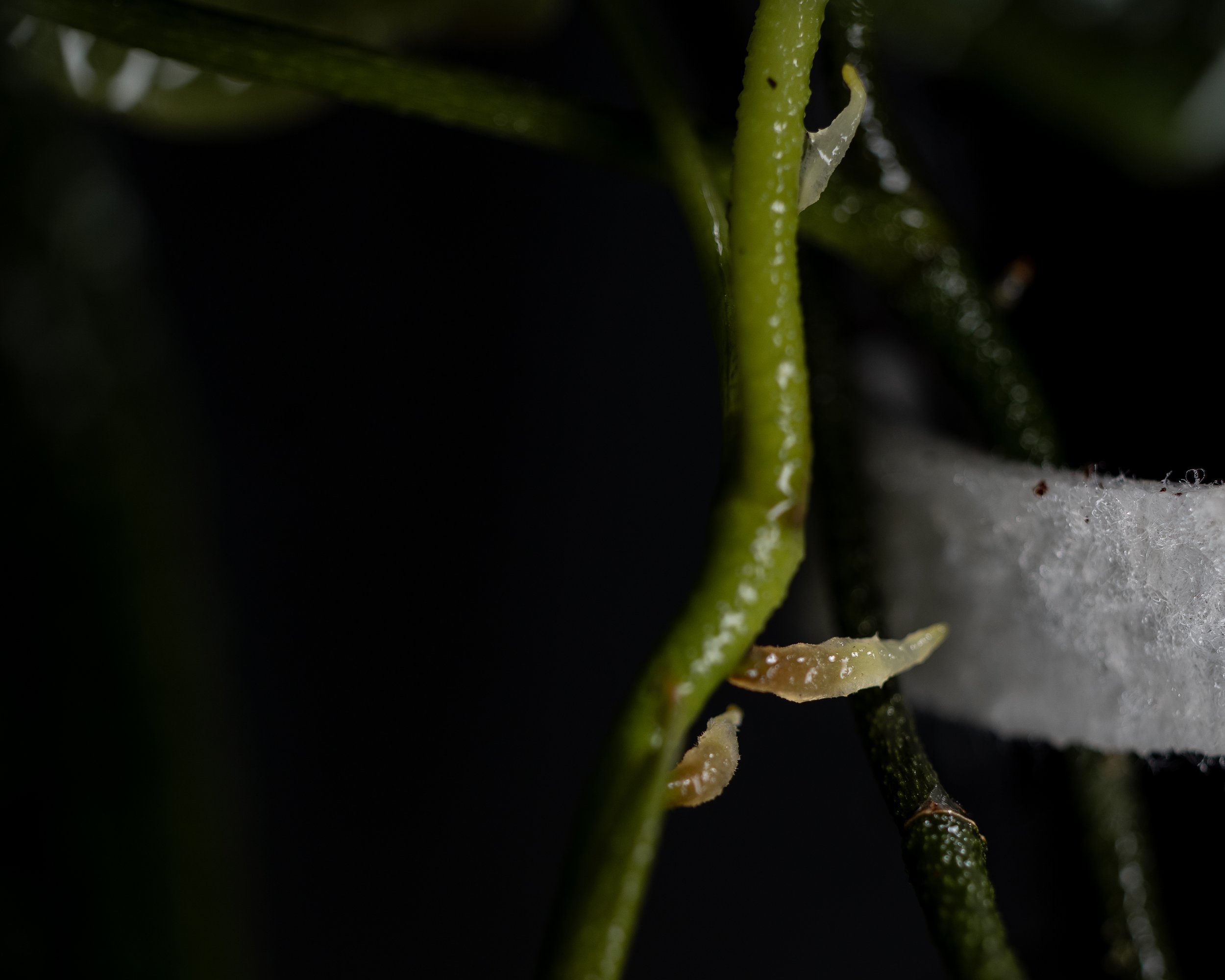
This root is ready to anchor.
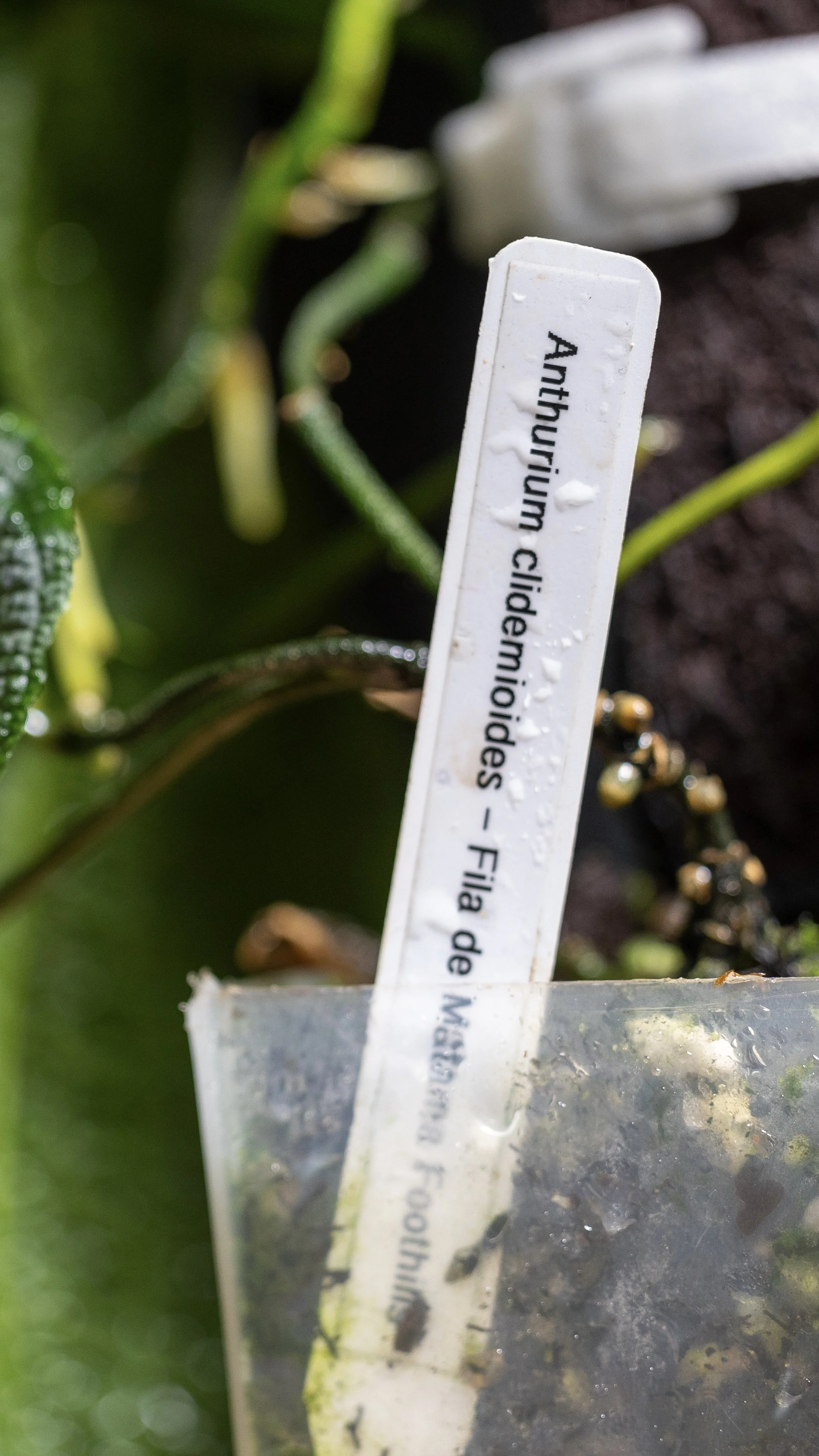
The Anthurium clidemioides growing here in the Garage is a clone collected from the foothills of the Fila de Matama, Costa Rica and belongs to section Polyphyllium: six species total, the earliest divergent lineage in the entire genus.
Its ancestors split from the rest of Anthurium roughly 10 to 11 million years ago, during the Late Miocene, while the mountains of Central America were still rising from the sea.
It climbs and that is unusual.
The other plants represented in the online plant collecting communities and horticulture in general are epiphytes or semi-epiphytes with a few terrestrial giants like Anthurium regale species sprinkled in.
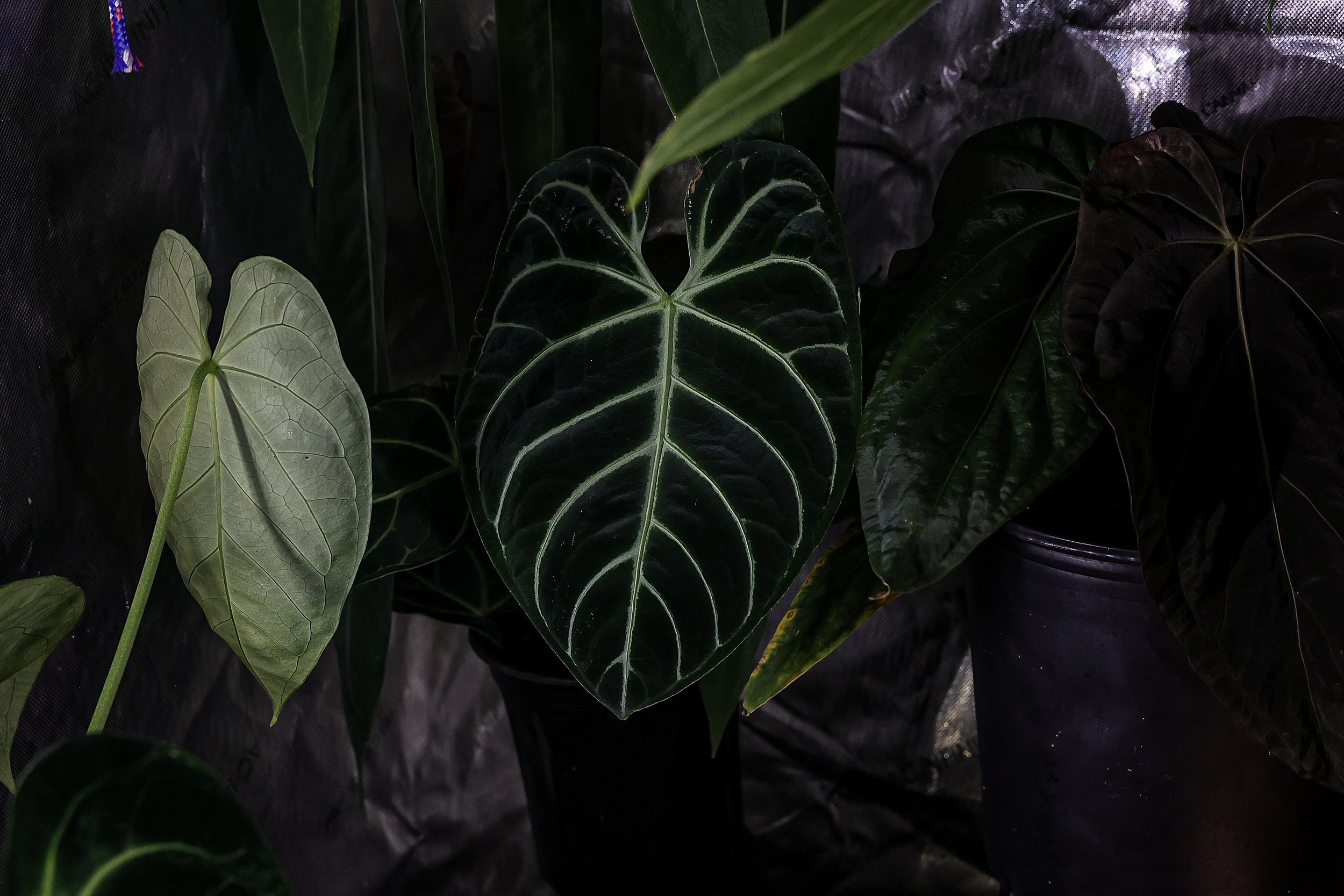
Anthurium regale ex-Moyobamba Waterworks, leaves get 3’ on this terrestrial species of Anthurium. Plant seen in this image from Feb 2023 is currently in a restarting phase as a tiny propagation right now. Anthuriums are known for being able to be propped from stem cuttings allowing a collector a few “lives” to work with when growing.
The Anthurium section Polyphyllium stayed small. Kept it climbing. Stayed weird.




For more on molecular studies of anthuriums I suggest MoBot’s TROPICOS
End of plant portion.
Continue at own risk.
Kinda Off Topic:
Here we explore how things can deviate from the norm and be load bearing simultaneously.
Lung skin, stars that orbit backwards, and Henry Cavendish.
An anthurium refusing to get big and stationary is a great example of atypical being advantageous.
Let’s zoom out a bit.
The plant discussed was originally collected by plant researchers in the misty Caribbean foothills of Costa Rica.
Just a couple hundred meters up that same ridge lives Nototriton picadoi, a moss salamander the size of your finger.
It has no lungs.
It breathes entirely through its skin; which sounds like a deficiency….
until you learn that it still expresses SFTPC, a gene that in every other vertebrate coats the interior of lungs to keep them from collapsing.
This animal repurposed a lung gene for skin. It conserved prior architecture and redirected it. The structure stayed. The context changed completely.
Both organisms are doing the same thing: using inherited tools in conditions those tools were never designed for. Neither is broken. Neither is optimal. Both are irreplaceable in the system they inhabit.
Scale out further and the pattern holds.
In 2020, radio astronomers found something that shouldn't exist: giant rings of emission so large they dwarf entire galaxies, with no clean explanation for what made them.
Radio Circles, ORCs: are giant rings of radio emission hundreds of thousands of light-years across. They form when a galaxy-group merger happens to coincide with remnant energy bubbles from an ancient active galactic nucleus. No single clean process makes them. They're accidents of timing, reusing leftover energy from an event that ended millions of years earlier. There are fewer than ten confirmed. They persist anyway.
Meanwhile in our own galaxy:
Stars in the Thamnos structure (a structure of star clusters in globular shapes) orbit backwards, aka: retrograde, and opposite to the galactic disk at roughly negative 150 kilometers per second. Debris from a dwarf galaxy the Milky Way swallowed but couldn't fully digest. Their momentum was conserved. They will orbit backwards essentially forever, unconverted, unoptimized, moving against the current of everything around them.
The universe appreciates the rough drafts.
Then there’s math…
Math has the square root of 2 it is irrational and cannot be expressed as a ratio of two integers. Reportedly this disturbed the Pythagoreans enough that one of them may have been drowned for proving it. The number e the base of natural logarithms, is irrational and transcendental, and it appears everywhere: compound interest, population growth, the curve of a hanging chain, the decay of radioactive elements. It wasn't designed for any of those things. It was discovered in the narrow problem of continuously compounded interest and turned out to be load-bearing across the entire structure of analysis.
Then there is Cantor's discovery that infinities are not all the same size. The infinity of integers is smaller than the infinity of real numbers. There are infinitely many sizes of infinity, nested inside each other. This was considered pathological when Cantor proposed it. His contemporaries called it a "fog." It is now foundational. The eccentric result turned out to describe the actual architecture of mathematics itself.
Lastly let’s bring this back to the human level: some of our most paradigm shifting concepts and structures essential to cohesive societal-functionality originate with individuals that operated on a unique wavelength.
Here’s a few:
Nikola Tesla — the obvious one, but earned. Celibate, obsessive, claimed to receive transmissions, talked to pigeons, couldn't touch round objects. Also basically invented the modern electrical grid. His eccentricity wasn't incidental to his genius — his ability to visualize entire working machines in his mind before building them was the same cognitive wiring that made normal social function difficult.
Ramanujan — arrives in Cambridge from Madras with almost no formal training, attributes his theorems to a Hindu goddess who writes them on his tongue while he sleeps. Hardy thought he was the most naturally gifted mathematician he'd ever seen. His "deficiency" — no formal proof methodology — meant he was finding things that trained mathematicians would never look for.
Simone Weil — philosopher, mystic, French Resistance, starved herself to death in solidarity with occupied France. Refused baptism her entire life despite being one of the most profound Catholic thinkers of the 20th century.
Her marginality from every institution she touched was precisely what gave her thought its integrity.
Georg Cantor — spent half his life in sanatoriums, was convinced God had personally revealed transfinite mathematics to him. His work on infinity was considered dangerous and possibly insane by the mathematical establishment.
He was right. It became the foundation of modern set theory.
Henry Cavendish was one of the most important scientists of the 18th century. He discovered hydrogen, calculated the gravitational constant, and anticipated both Ohm's Law and Dalton's Law by decades.
He was also a man who existed almost entirely outside normal human exchange. He communicated with his household staff by written note. He built his life around the work, not around being seen doing it. He never published most of what he discovered.
A century later, James Clerk Maxwell — while having already unified electricity and magnetism into a single coherent theory — went through Cavendish's unpublished papers and found the underpinnings of his own work sitting there, quiet and intact. Maxwell named his Cambridge laboratory after Cavendish.
He didn't have to do that. He did it anyway.
All of it tracing back to a man who simply preferred the work to the world.
The point of all this isn’t that everything is fine.
The climbing anthurium, the lungless salamander, the eccentric mathematician — none of them are fine or not fine. They simply are, operating within a system that has no preference for outcomes the way we do.
That distinction matters. Human moral frameworks — even the most rigorous ones — tend to be built around human experience as the reference point. Kantian ethics grounds moral worth in rational agency. It’s a powerful system, and also a narrow one. It has trouble accounting for the salamander, the ecosystem, the star cluster moving against the current of everything around it.
Recognizing that the universe runs without our agenda isn’t a reason to abandon moral thinking. It’s an invitation to recalibrate it — to ask what falls outside the frame we inherited, and whether it deserves to be there. And maybe more importantly: to stop holding the underlying structure of everything to standards it never agreed to. Whether you call that structure God, evolution, or Tegmark’s proposition that physical reality is simply mathematics that exists because mathematics exists — none of it was arranged for our approval.
Expecting it to conform to our values isn’t moral seriousness. It’s a category error dressed up as one.
The anthurium stayed small and kept climbing. The salamander repurposed a lung gene for skin. The backwards stars will orbit that way essentially forever, unconverted, unoptimized.
None of it is asking for our verdict.
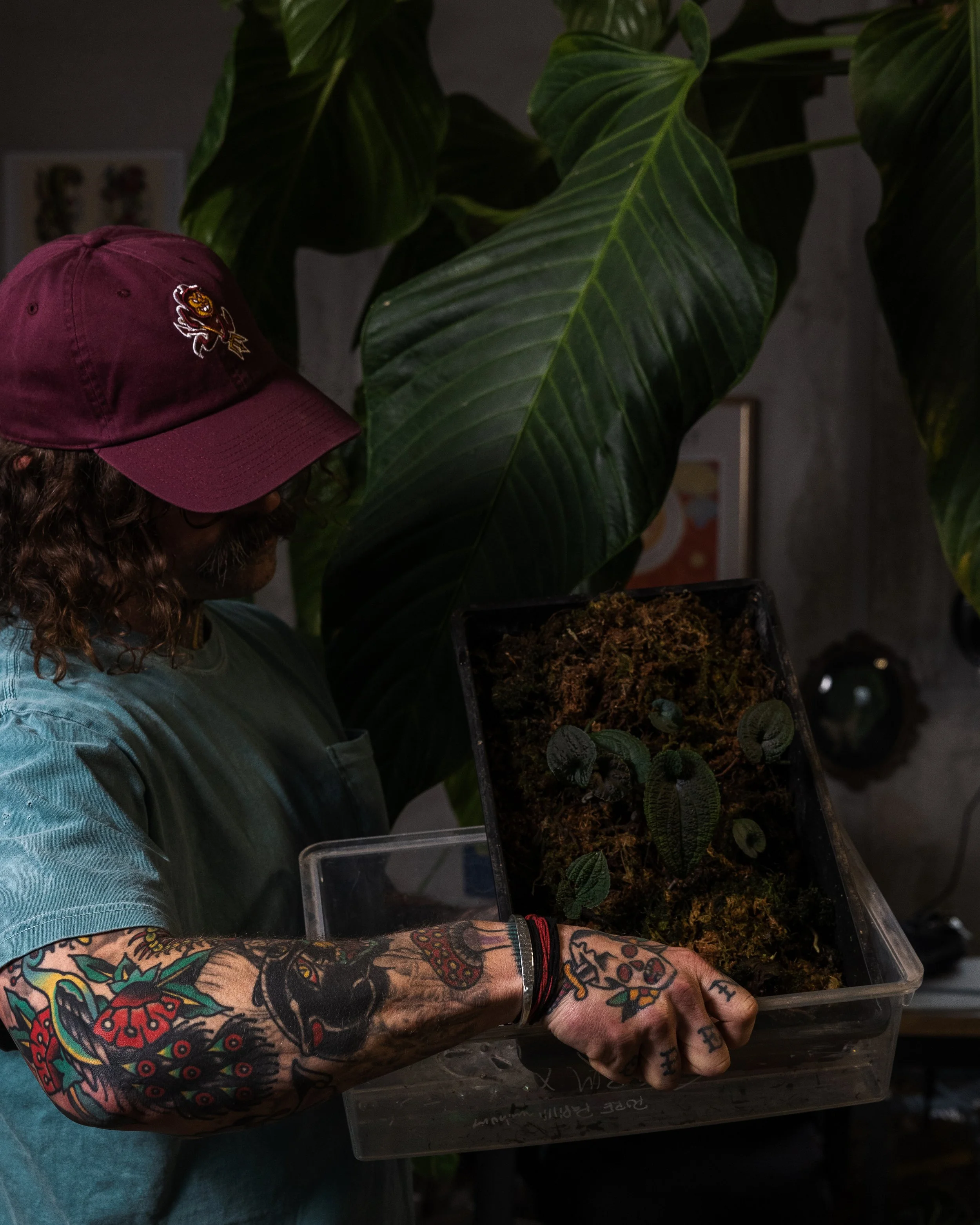
All images copyright Exotica Exportare LLC
Plants grown in Author’s indoor collection in N.C.
Claude Ai was used for proofreading and research purposes.