Is a Vital Biodiversity Database Going Dark?
PLANT NEWS / AUGUST 2026
Is a Vital Biodiversity Database Going Dark?
A Florida server shutdown will erase some media files and break some links. That is serious. It is not the same as GBIF—or all of iDigBio—disappearing.
On August 31, 2026, iDigBio will permanently shut down its media servers at the University of Florida. According to its official warning, files physically stored on those servers will be deleted. Records that still point to those servers may also lose their images in GBIF and other aggregators.
That sounds like a national biodiversity database going dark. It is not quite what is happening. The distinction matters because the real story is more instructive: a successful, grant-funded project became part of the working infrastructure of science, while some of its storage remained temporary.
What, exactly, is iDigBio?
iDigBio—Integrated Digitized Biocollections—was established in 2011 as the national coordinating resource for the National Science Foundation’s Advancing Digitization of Biodiversity Collections program. It was based at the Florida Museum of Natural History and led by the University of Florida with Florida State University and other partners.
It performed several related jobs:
Aggregated standardized records from museums, universities and other biological collections.
Created a searchable national portal for specimen records and media.
Coordinated thematic networks of institutions digitizing related groups of specimens.
Developed workflows, training programs and technical standards for digitization.
Worked with collection-management systems and portals, including the Symbiota network.
Connected U.S. specimen data with larger international infrastructure, especially the Global Biodiversity Information Facility, or GBIF.
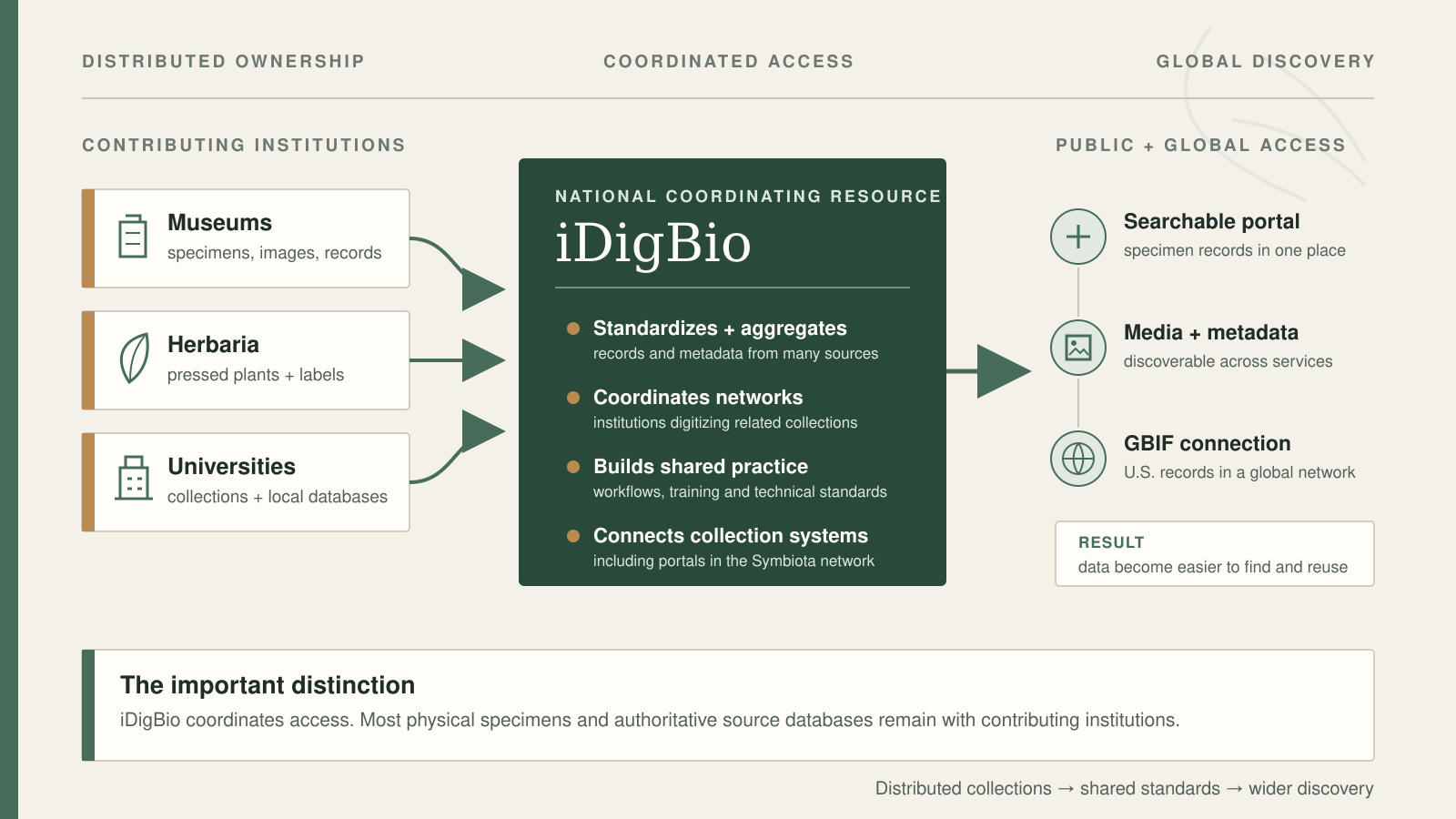
iDigBio does not own most of the physical specimens, and it is not necessarily the authoritative database for each collection. Those specimens and institutional records remain distributed among the contributing museums, universities and agencies. iDigBio made that distributed system more searchable, standardized and usable.
By 2026, the scale was substantial: nearly 150 million specimen records and 65 million media files contributed by more than 1,000 U.S. institutions were accessible through the portal. iDigBio sustainability overview.
Why does it matter?
The micro scale
A natural-history specimen is a physical claim that can be revisited. A pressed plant, pinned insect or preserved fish carries a label: where it was collected, when, by whom and under what name. Digitization turns that isolated object into searchable evidence. A researcher can compare records across collections without first traveling to every museum that holds them.
Images add another layer. They can expose morphology, label history and collection condition, and they can help a researcher decide which physical specimens deserve closer examination. They do not replace the specimen, but they change who can encounter it and what questions can be asked before a loan or visit is necessary.
The macro scale
Once millions of records are standardized, the collection becomes more than a cabinet-by-cabinet inventory. Researchers can examine changes in distribution, flowering time, invasion, extinction risk and collecting bias across decades or centuries. The value emerges from coordination: many small records become a system capable of showing patterns no single collection contains.
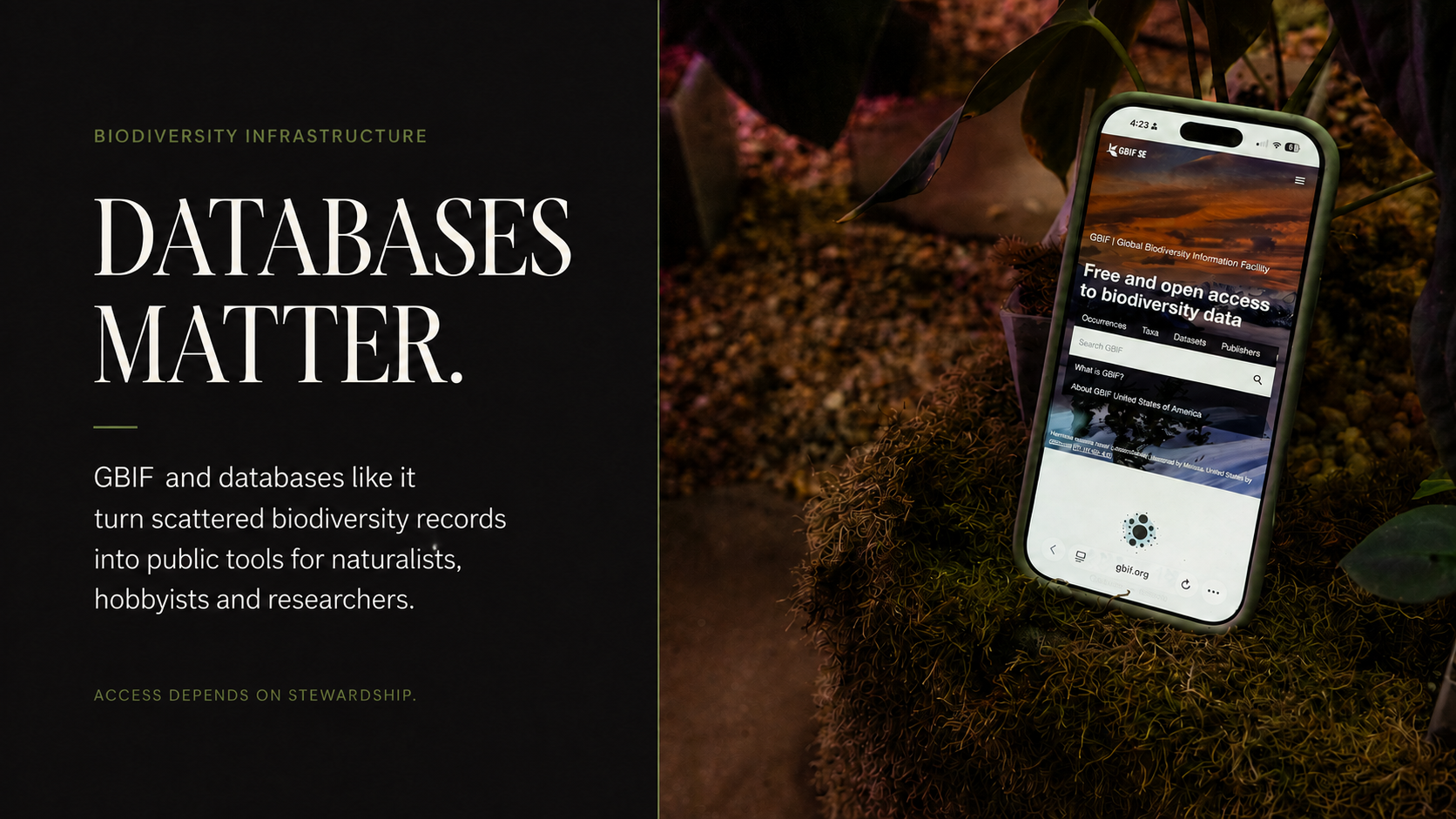
The same access matters outside professional institutions. An amateur naturalist can use GBIF occurrence records alongside taxonomic resources such as Kew’s Plants of the World Online and Tropicos to test a tentative identification or distribution claim. Those databases do not turn a photograph into a verified determination, but they make it easier to ask a more responsible question and to see where the available evidence is thin.
What is actually going dark?
GBIF itself is not shutting down. iDigBio reports that more than 98 percent of its providers are now registered with and serving specimen data through GBIF. Its new GBIF-hosted portal is intended to become the public face of iDigBio, while the legacy iDigBio portal and API are expected to remain available through 2026 even though data ingestion stopped in May. iDigBio transition notice.
The vulnerable layer is more specific: media files stored on the University of Florida servers, plus records whose media links still point to those servers. For an affected image to remain accessible, its collection must move the file to durable storage, update the file address in its records and republish those records to GBIF or another aggregator. If one step is missed, the specimen record may remain online while its image disappears.
The University of Kansas team supporting Symbiota portals has said it will try to transfer affected media and repair linkages where possible. Other collections must review their own records. This is not primarily a task for GBIF, Kew or Tropicos to solve; responsibility begins with the institutions that control the files and publish the records.
No official notice says that all 65 million media files represented in iDigBio will be deleted. The warning applies to files physically stored on the retiring servers and to links dependent on them. iDigBio’s public notice does not provide a verified total for the affected subset.
Where did the money come from?
The central iDigBio project received approximately $45.5 million across three five-year NSF phases:
2011 — $10 million to the University of Florida and Florida State University to create the coordinating hub. University of Florida history.
2016 — $15.5 million for a second five-year phase. At that point, the portal held more than 64 million specimen records and 14 million images. Florida Museum announcement.
2021 — nearly $20 million for the third phase, with an explicit focus on sustaining digitization, access and community infrastructure. Florida Museum announcement.
That total does not include the separate NSF awards made to Thematic Collections Networks, which paid institutions to digitize particular groups of specimens and mobilize their data through the larger system.
iDigBio has received a no-cost extension that allows some work to continue into 2027. A no-cost extension adds time, not money: the recipient may continue using funds already awarded. The media servers are still scheduled to shut down on August 31, 2026.
This distinction changes the causal story. The servers are not being shut down because an active award was suddenly cancelled. The third phase was created in 2021 with a defined duration, and the central project is now entering its planned wind-down.
The useful history of NSF
NSF emerged from a postwar argument about how publicly funded science should be organized.
In 1944, President Franklin D. Roosevelt asked Vannevar Bush how the scientific apparatus assembled during World War II could be carried into peacetime. Bush’s 1945 report, Science: The Endless Frontier, argued that the federal government should support basic research while allowing scientists substantial independence in deciding which work merited support.
Senator Harley Kilgore had advanced a different model: a broader organization supporting basic and applied research, distributing funds more geographically and remaining more directly accountable to political authority. Bush emphasized scientific autonomy and competitive excellence. The legislation that finally created NSF in 1950 emerged from five years of conflict and compromise over those questions. NSF’s historical narrative.
The durable arrangement can be summarized this way: scientific proposals are evaluated largely through scientific expertise, but the money remains public and the institution remains accountable through democratic government.
How NSF funding reaches a project
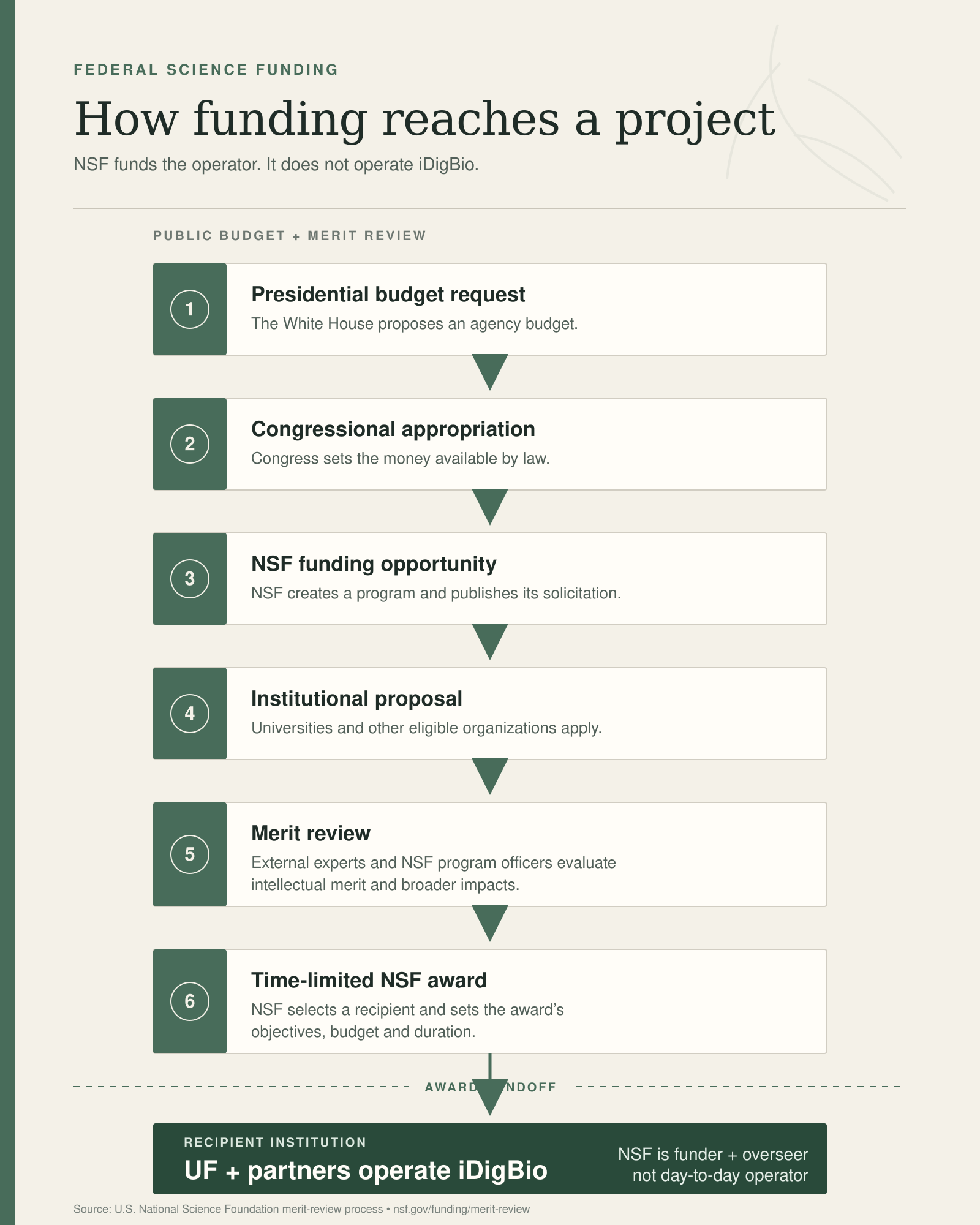
The president proposes an agency budget.
Congress appropriates the actual money.
NSF creates funding programs and publishes solicitations.
Universities and other eligible institutions submit proposals.
External experts and NSF program officers evaluate intellectual merit and broader impacts.
NSF makes time-limited awards to recipient institutions.
NSF therefore did not directly operate iDigBio. It funded the University of Florida and its partners to operate the project under awards with defined objectives, budgets and durations. NSF merit-review process.
The current political context
The timing is politically charged. The president’s fiscal year 2026 request proposed $3.9 billion for NSF, compared with the agency’s $9.06 billion fiscal year 2025 enacted level. Congressional committees considered substantially higher figures, which demonstrates why a presidential request should not be confused with an appropriation. NSF budget request; Congressional Research Service summary.
It is accurate to say that iDigBio’s transition is occurring during a period of intense pressure on federal science budgets. It is not accurate, based on the evidence currently available, to say that new budget cuts caused the August 31 server shutdown. The award already had a terminal point when the third phase was announced in 2021.
Nor are budget cuts deleting 65 million images. That number describes the media records accessible through the portal, not the verified number of files stored on the retiring Florida servers. The immediate loss may be narrower. The structural problem is larger.
A project became infrastructure
The problem is not simply that a grant ended. Grants are supposed to end. The problem is that a successful project became part of the nation’s scientific infrastructure without acquiring a settled system of permanent stewardship for every layer on which access depended.
A biodiversity database is not one server, one grant or one institution. It is a coordinated relationship among physical specimens, collection workers, digitizers, standards, file hosts, stable identifiers, aggregators and public funding. No component contains the network by itself. Durable access emerges only while those components continue working together. When one supposedly temporary layer becomes structurally important, its removal can propagate outward as broken links across systems that remain otherwise operational.
It would therefore be misleading to reduce this to NSF switching off iDigBio—or to a single villain pulling a plug. The more responsible question is what continuity public science requires once a temporary award begins producing permanent expectations. Scientific grants operate on fixed terms. Collections, accumulated records and the questions researchers ask of them do not. The tension between those two timescales is where this story lives.