
Chorigyne cylindrica.
A fan of leaves, a 1:4 floral rule, and a genus science did not name until 1989
Species: Chorigyne cylindrica R.Erikss.
Family: Cyclanthaceae
Subfamily: Carludovicoideae
Order: Pandanales
Habit: Epiphyte
Native range: Costa Rica and Panama
First published: Nordic Journal of Botany 9: 44, 1989
Here we have Chorigyne cylindrica.
Its rigid, pleated leaves alternate to the left and right, forming a fan within a single plane. In the grow tent, surrounded by the broader, darker leaves of anthuriums, the plant fills its allotted space as though it had been designed for the opening.
It is still settling in after traveling from the Bay Area greenhouse where it was cultivated. So far, the transition appears successful. Its leaves remain upright and glossy. More surprisingly, it arrived carrying reproductive structures.
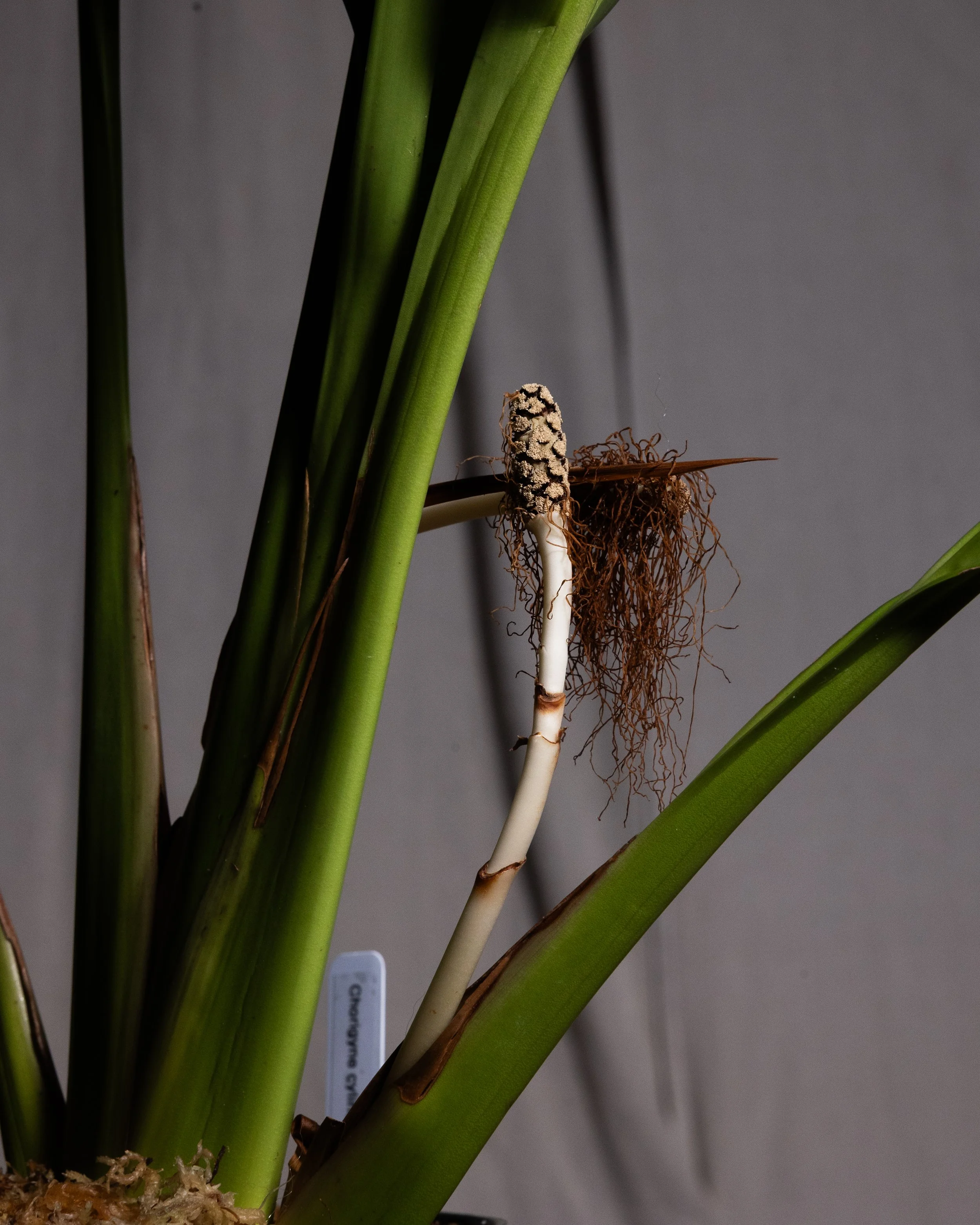
One looks as though it has exploded into a tangle of orange wire. Another resembles a pale cylindrical puzzle raised on an extending peduncle. The perfume is faint but persistent—not enough to fill the room, but present whenever I move close to the plant.
Nothing about it appears simple once the scale changes.
A Recently Named Genus
Cyclanthaceae is not new to science. The family was formally named in 1824, and Gunnar Harling published its foundational modern monograph in 1958. Chorigyne, however, is much more recent.
Roger Eriksson established the genus in 1989, making it the most recently described genus in the family. Chorigyne cylindrica was described in the same paper.
Cyclanthaceae now contains roughly 230 recognized species distributed among 12 genera. Chorigyne contains seven accepted species, all native to Costa Rica and Panama. Its type species is Chorigyne ensiformis.
The plant itself is not recently evolved, of course. It was only recently separated and named by us.
The name comes from the Greek choris, meaning “apart,” and gyne, meaning “woman” or “pistil” in botanical compounds: separate pistils. It refers to the fruits remaining completely or almost completely separate within the infructescence.
The Fan
The fan-shaped distribution of the leaves is called distichy. Leaves emerge in two alternating ranks along a single plane rather than rotating around the stem in a spiral.
This arrangement is especially characteristic of Chorigyne and its close look-alikes Sphaeradenia and Stelestylis. Their stiff, conspicuously pleated leaves can make them resemble palms, although Cyclanthaceae belongs to Pandanales rather than the palm family.
Distichy is why this plant occupies the grow space so effectively. It does not distribute its leaves equally in every direction. It organizes them into a broad, compressed plane: a living fan inserted between the surrounding plants.
The Apparent Explosion
The pale cylinder is not one flower.
It is a spadix: a compact axis carrying many small flowers. The entire flower-bearing structure is an inflorescence—a reproductive shoot system composed of multiple flowers and the structures supporting them.
The modified leaves are the spathes, protective bracts produced along the upper portion of the peduncle. The reddish structure visible near the base is one of these spathes. It protected the developing inflorescence and is now being shed.
Across the spadix, the flowers repeat a characteristic Carludovicoideae rule: one pistillate flower surrounded by four staminate flowers. Each 1:4 group forms a partial inflorescence. Repeated around the cylinder, these units produce a spiral tessellation—a botanical mosaic of tightly packed reproductive parts.
The orange tangle is not composed of spent staminate flowers. The threads are staminodes: sterile, stamen-like structures belonging to the pistillate flowers. In studied cyclanths, these staminodes function as osmophores—scent-producing tissues used to attract small weevils.
The family’s reproductive period is called anthesis, not antithesis. In studied members of Carludovicoideae, anthesis is protogynous: the pistillate phase occurs first, followed by the staminate phase. The staminodes extend and release fragrance during the earlier phase, then collapse or detach as the inflorescence moves through its reproductive sequence.
The tangled orange mass therefore appears to record a transition.
What looks like botanical wreckage is the residue of an organized sensory and reproductive event.
Why the Geometry Matters
Evolution does not have to invent an entirely new organ to produce a new floral architecture.
A small developmental change—when a structure begins growing, where two tissues fuse, how quickly one part expands or where a flower initiates—can be repeated across an entire spadix. Change one local rule and the complete geometry changes with it.
The visible form is therefore more than decoration. It is the accumulated result of developmental instructions being executed again and again:
One pistillate flower.
Four staminate flowers.
Another partial inflorescence.
Another turn of the spiral.
Increase the zoom far enough and the puzzle becomes a process.
Lumpers and Splitters
Taxonomy contains its own persistent disagreement.
Splitters preserve fine distinctions and create more narrowly defined groups. Lumpers combine similar organisms when the differences appear too slight, unstable or semantically inflated.
Chorigyne sits directly inside that argument.
A 2022 molecular study recovered all 12 currently recognized Cyclanthaceae genera as distinct lineages. However, the authors also noted that Chorigyne, Stelestylis and Sphaeradenia are strikingly similar. In some cases, they can be distinguished only by the number and position of placentas inside dissected ovaries.
The researchers did not rule out combining them in the future, but concluded that more evidence is needed before the classification is changed.
So which instinct is yours: preserve the distinctions or collapse them?
The responsible answer may be neither by default. Taxonomy is not a contest to produce the greatest or smallest possible number of names. It is a working model that changes as morphology, molecular evidence and evolutionary history are brought into better alignment.
A Restricted Lineage
Cyclanthaceae as a whole is not confined to lower Central America. The family extends through wet Neotropical habitats from southern Mexico and the Caribbean into South America, reaching the Atlantic Forest of southern Brazil.
Chorigyne is much more restricted. The entire genus is native only to Costa Rica and Panama. Chorigyne cylindrica is known from wet forests in both countries, where it grows primarily as an epiphyte, including as a subcanopy plant in Panamanian forest.
Why should a plant apparently requiring little more than warm, wet, shaded forest not occur everywhere those conditions exist?
Because climate is not the same thing as history.
The present distribution of Cyclanthaceae reflects ancient movement, fragmented forests, dispersal limits, mountain building, expanding dry regions and extinction. The uplift of the Andes and the development of South America’s dry diagonal divided habitats that may appear broadly equivalent when reduced to temperature and rainfall.
A wet tropical biome is not one continuous room into which a lineage can expand freely.
Habitat tells us where a species might survive. Evolutionary history helps explain where it actually arrived.
A Family Carried Into Human Culture
There is no established human use presented here for Chorigyne cylindrica itself. One of its relatives, however, connects Cyclanthaceae to Wounaan and Emberá basketry in eastern Panama.
Artisans use fibers from the chunga palm, Astrocaryum standleyanum, sewing them around a structural foundation made from Carludovica palmata, a member of Cyclanthaceae. Research published in 2001 found that destructive harvesting of the chunga palm’s spear leaves threatened the continued supply of fiber and recommended more sustainable management.
This is not a use of Chorigyne. It is a reminder that a botanical family can also become part of a material network: forest plants, human knowledge, trade, land management and cultural continuity joined through construction.
Back in the grow tent, Chorigyne cylindrica continues to look perfectly placed.
Its geometry records several kinds of order at once: leaves alternating in two ranks, flowers repeating a 1:4 rule, scent released for weevils, and a scientific name that has existed for less than four decades. Even that name may eventually be reorganized.
From a distance, the plant is a fan.
Increase the zoom and it becomes a set of relationships still being sorted.
Sources and Further Reading
Kew Science: Chorigyne R.Erikss.
Teichert, H. 2008. Floral Scent and Reproductive Biology in Cyclanthaceae.
Leal et al. 2022. Molecular Phylogenetics and Classification of Cyclanthaceae.