
Boltzmann
Boltzmann: The 15 Things He Actually Did
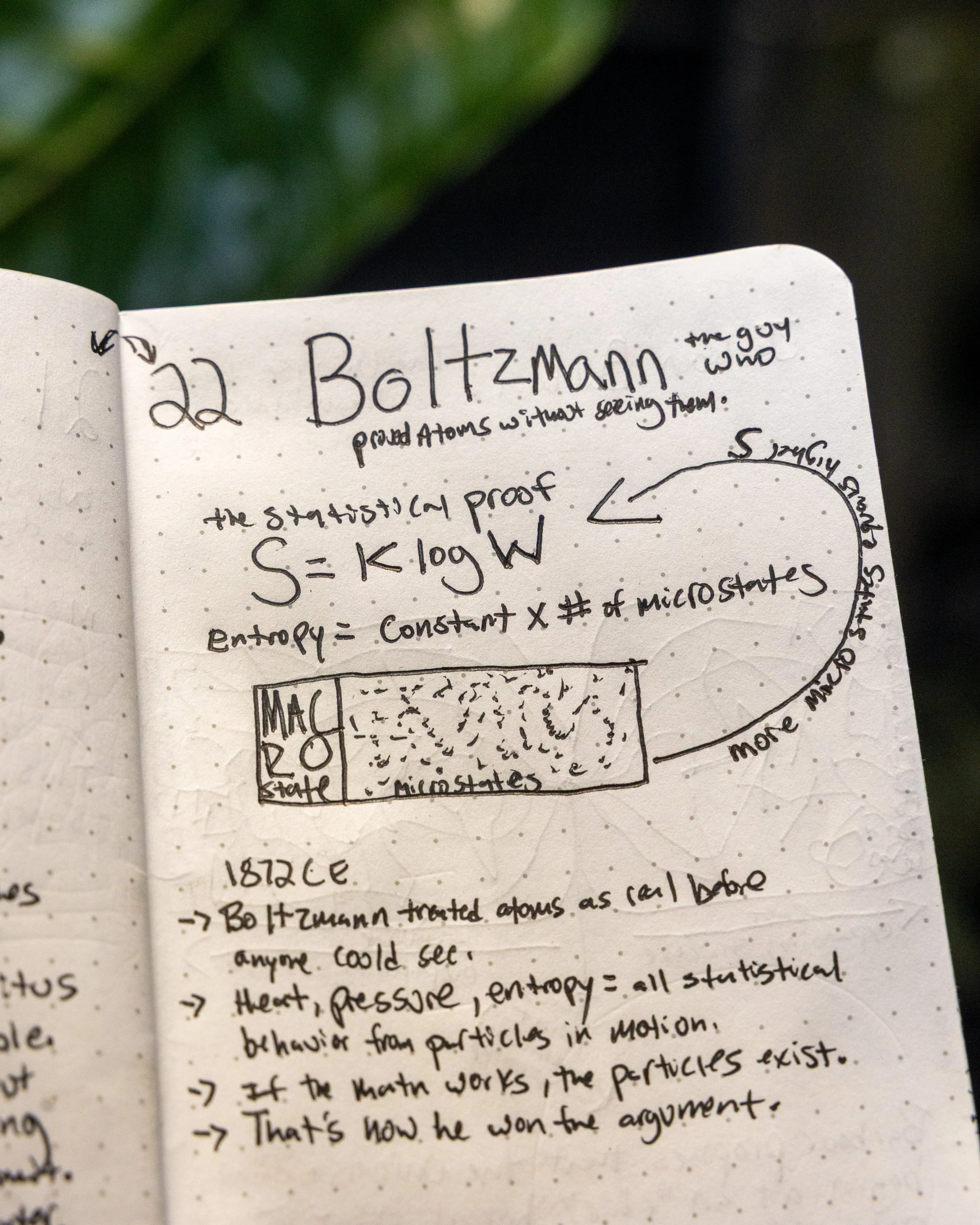
1. He proved atoms without seeing them.
His statistical predictions about gas behavior only make sense if atoms exist — a radical claim at a time when many physicists still thought atoms were philosophical props.
2. He linked microstates to macrostates.
Boltzmann showed how large-scale properties like pressure and temperature emerge from countless unseen particle motions.
3. He turned thermodynamics into statistics, not fate.
Entropy isn’t a decay force. It’s just the probability distribution of possible arrangements.
4. He reframed entropy as counting.
Entropy = the number of microscopic configurations that match what you observe.
More possible arrangements → higher entropy. Full stop.
5. He wrote the famous formula: S = k log W.
Engraved on his tombstone:
S = entropy
W = number of microstates
k = Boltzmann’s constant
This equation reshaped modern physics.
6. He made time’s arrow statistical, not fundamental.
Time “moves forward” only because systems drift toward more probable states — not because the universe commands decay.



7. He revealed the reversibility paradox.
If microscopic laws are reversible, why does entropy increase?
Boltzmann’s answer: probability, not contradiction.
8. He proposed the H-theorem.
He derived that the H-function (related to entropy) decreases over time in a gas. Critics attacked it relentlessly; he improved it rather than abandoning it.
9. He clarified what equilibrium actually is.
Equilibrium isn’t mystical balance — it’s the macrostate with the highest probability of occurring.
10. He introduced the idea of fluctuations.
Given a large enough universe, improbable low-entropy pockets can form by chance.
This idea later inspired the “Boltzmann Brain” thought experiment.

11. He anticipated cosmic timescales and multiverse-like logic.
He considered the possibility that rare ordered regions (like ours) arise statistically in an enormous universe.
12. He was misunderstood because he was ahead of his time.
Physics in the 1800s wanted certainty and mechanism.
Boltzmann offered statistics — and looked like a heretic for it.
13. Einstein and others eventually proved him right.
Einstein’s 1905 Brownian motion work provided direct evidence for atoms, vindicating Boltzmann’s entire program.
14. His work became the backbone of statistical mechanics.
Modern thermodynamics, quantum statistics, cosmology, and even information theory all rest on Boltzmann’s foundation.
15. His meta-premise: the universe is legible through probability, not determinism.
He didn’t reject determinism — he reframed it.
To understand the world, you don’t track every particle; you understand the ensembles.

Anthuriums flanking ‘Black Magic’, ‘Voodoo Child’, and Morticia’s Magic.