Sixteen Percent
Kicker: Funding Slot: Report
Standfirst (Squarespace excerpt field): Kew finished photographing all 7.4 million specimens in its Herbarium and Fungarium. The report announcing it says fewer than one in six of the world's specimens have had the same done, and that the ones that have are almost all in wealthy countries.
Four high-resolution cameras. One hundred staff and forty-two volunteers. Four years. At the end of it, every one of the 7.4 million plant and fungal specimens at the Royal Botanic Gardens, Kew has been photographed, its label transcribed, and the result put on a public portal.
That is a finished thing, which is rarer than it sounds and worth saying plainly before anything else.
Kew announced it on 16 June alongside the sixth State of the World's Plants and Fungi report, subtitled "The Digital Biodiversity Revolution." The report runs to 55 pages, carries 414 authors from more than 170 institutions across 40 countries, and arrives with 52 open-access papers in New Phytologistand Plants, People, Planet. By the standards of institutional science reporting it is enormous, and it is free.
The number in the middle of it
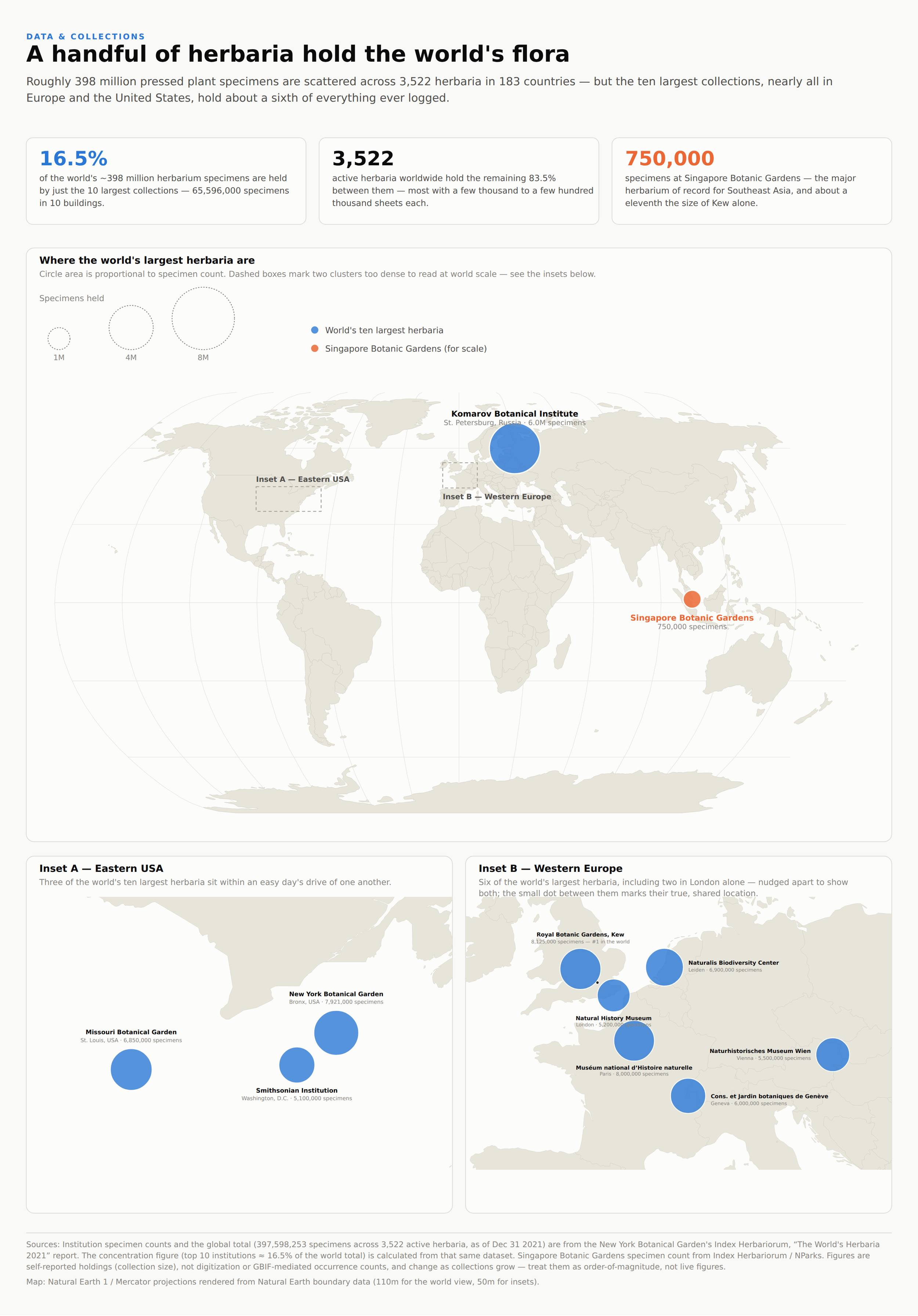
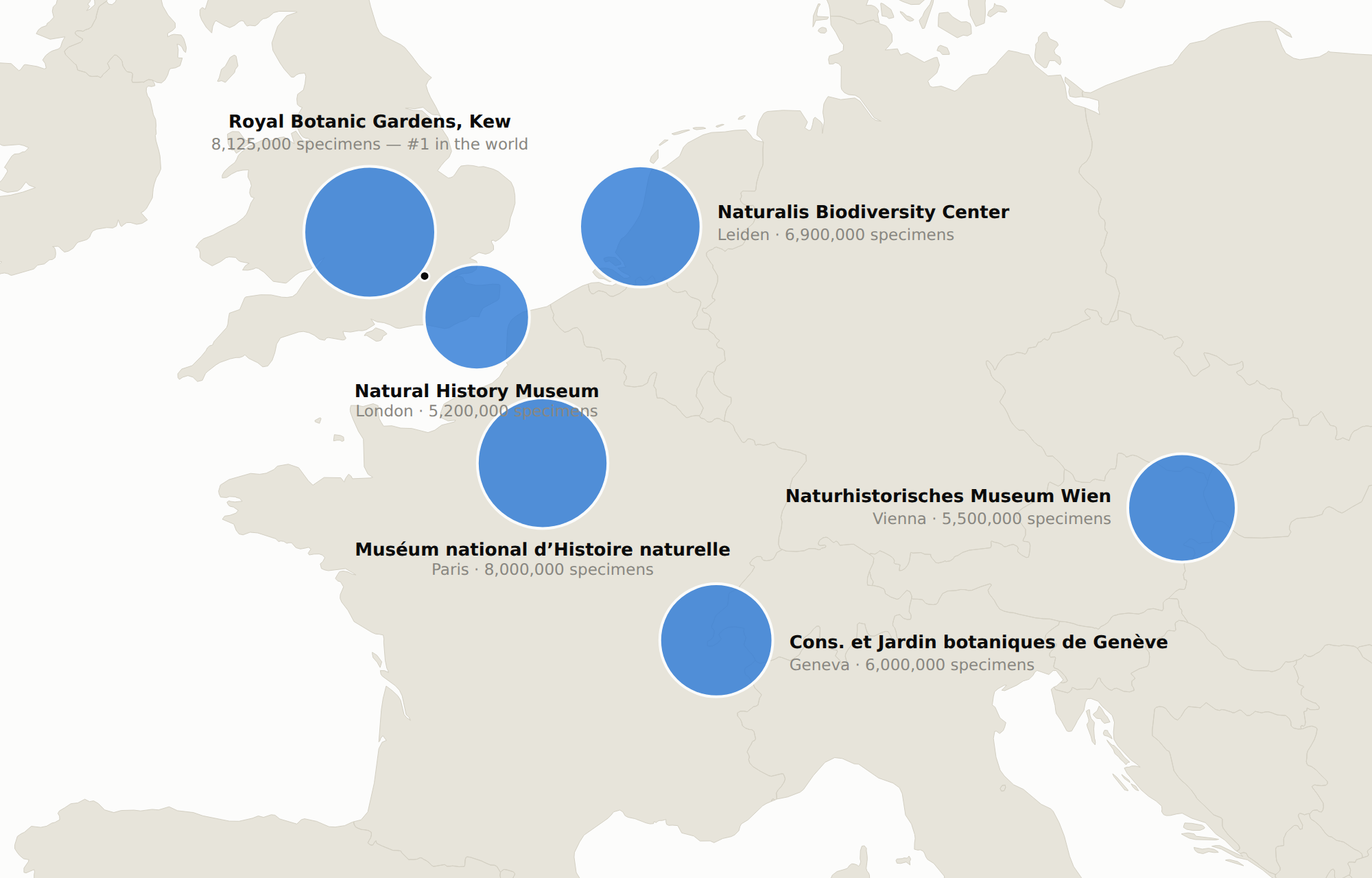
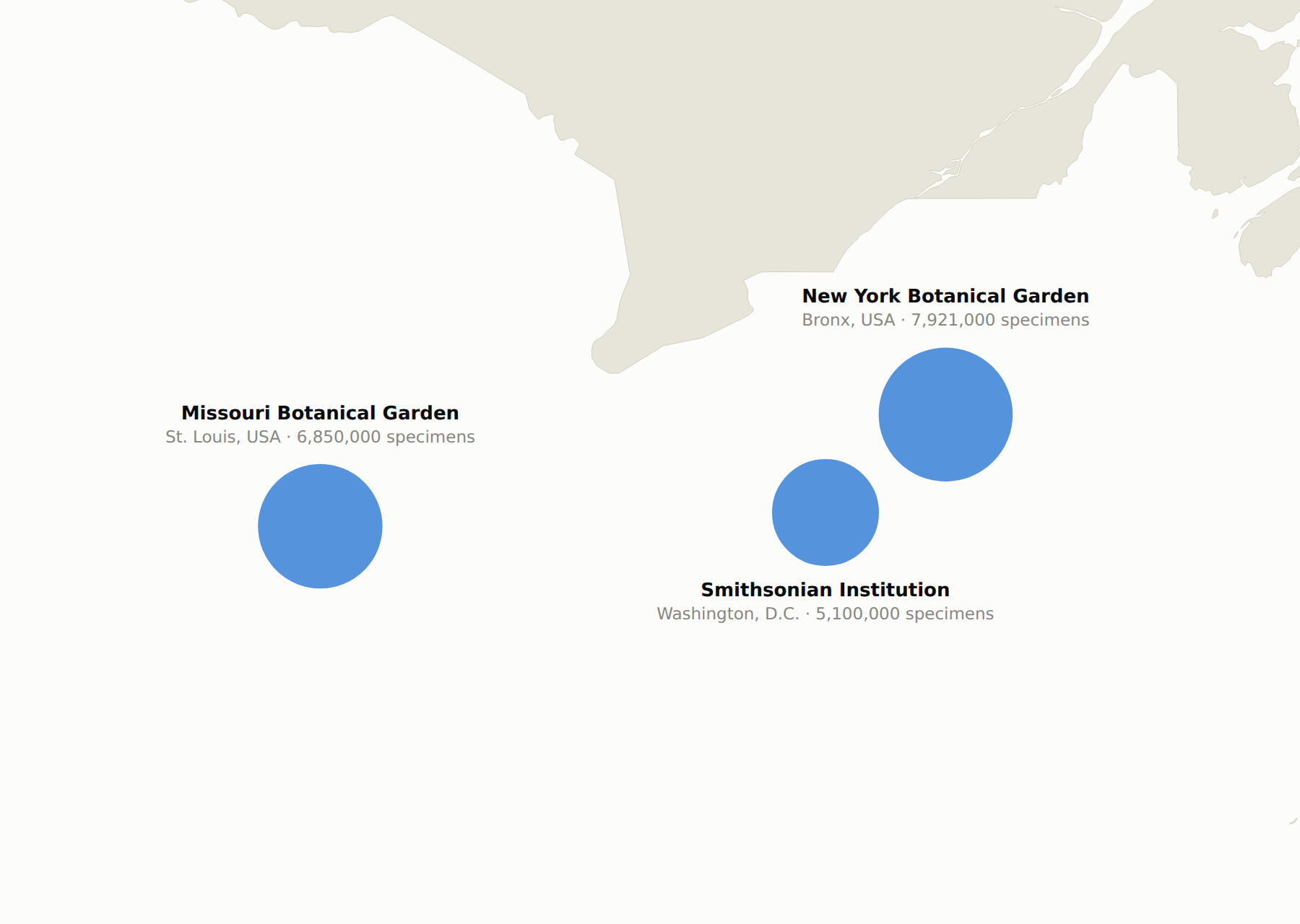
There are roughly 406 million herbarium specimens in the world. Fewer than 16 percent have been imaged and put online.
The rest exist only as physical objects in cabinets, which means they are available to whoever can get to the building. And the digitized share is not evenly distributed — it sits overwhelmingly in the Global North. The report is explicit that this is why we know less about biodiversity, conservation, and climate change everywhere else, and it calls for digitization funding aimed specifically at herbaria and fungaria in biodiverse, low-income countries.
Read that as a map of money rather than a map of technology. Nothing about the cameras is hard to obtain. What Kew had was four uninterrupted years, a hundred people, and funding from Defra, a corporate imaging partner, and a pile of bequests. The technology is solved. The staffing and the four years are not, and they are unevenly available in precisely the places holding the specimens nobody has looked at.
What is still unnamed
About 400,000 plant species have been described. Perhaps another 100,000 are waiting. For fungi the ratio is worse: roughly 205,000 species classified against an estimated two million or more, meaning under a tenth of the kingdom has a name.
More than 4,600 plants and 7,800 fungi were named new to science across 2024 and 2025, and a good share of them had been sitting in collections for years before anyone got to them. The ghost palm of Borneo, Plectocomiopsis hantu, was described 92 years after it was collected. The specimen was never lost. It was in a cabinet, undescribed, for nine decades.
That is the argument for digitization stated as concretely as it can be stated. A photographed specimen with a transcribed label can be found by someone who was not looking for it, from somewhere else, without a plane ticket.
The part Kew says out loud
Martin Cheek, a senior research leader at Kew, is quoted in the report's coverage saying that the potential for AI is enormous, but it is still currently potential.
That sentence is doing real work in a document whose subtitle contains the word revolution, and it should be read as the report checking itself rather than as a hedge. Machine identification of specimens from images is promising and not finished. What is finished is duller and more useful.
An example: a Harvard team led by Jeannine Cavender-Bares, with postdoctoral researcher Dawson White, tested reflectance spectroscopy — measuring how light bounces off leaf tissue — on pressed herbarium sheets. They found the spectral data predicted functional traits such as leaf mass per area nearly as well as measurements from fresh material. That is a specific, checkable result, and its consequence is large: a century of pressed leaves becomes a dataset about how plants actually function, not just a record of what grew where.
What this is next to
The iDigBio report elsewhere in this issue describes a storage layer switching off because a grant reached its written end date. This one describes a four-year digitization project reaching completion because it was funded to completion. Nobody planned these two things to land in the same month and there is no lesson connecting them.
There is a shared question, though, and the Kew report raises it without answering it: 406 million specimens is a number that only goes up, and every one of them digitized becomes a file that somebody has to keep. The report is a case for spending money on the imaging. What it does not cost out is the century of hosting that follows, which is the bill that comes due long after the photographers have gone home.
The report is free, the 52 papers are open access, and Kew's portal is public — none of which requires a login or an institution. If you want to go further in, the terms are digitisation, reflectance spectroscopy, and the 2030 Declaration on Scientific Plant and Fungal Collecting, which came out of the 2023 symposium and has collected close to a thousand signatures from 90 countries.
Sources
Royal Botanic Gardens, Kew. State of the World's Plants and Fungi 2026: The Digital Biodiversity Revolution.Published 16 June 2026. https://www.kew.org/science/state-of-the-worlds-plants-and-fungi
Kew summary, "Is technology nature's ally?" https://www.kew.org/read-and-watch/sotwpf-2026-summary
Kew press release, 16 June 2026. https://www.kew.org/about-us/press-media/state-of-worlds-plants-fungi-2026
New Phytologist Foundation special collection, "Harnessing the Benefits of Specimen Digitisation" — 52 open-access papers in New Phytologist and Plants, People, Planet.
Harvard University Herbaria, on the Cavender-Bares and White spectroscopy work. https://www.huh.harvard.edu/news/2026/06/state-worlds-plants-and-fungi